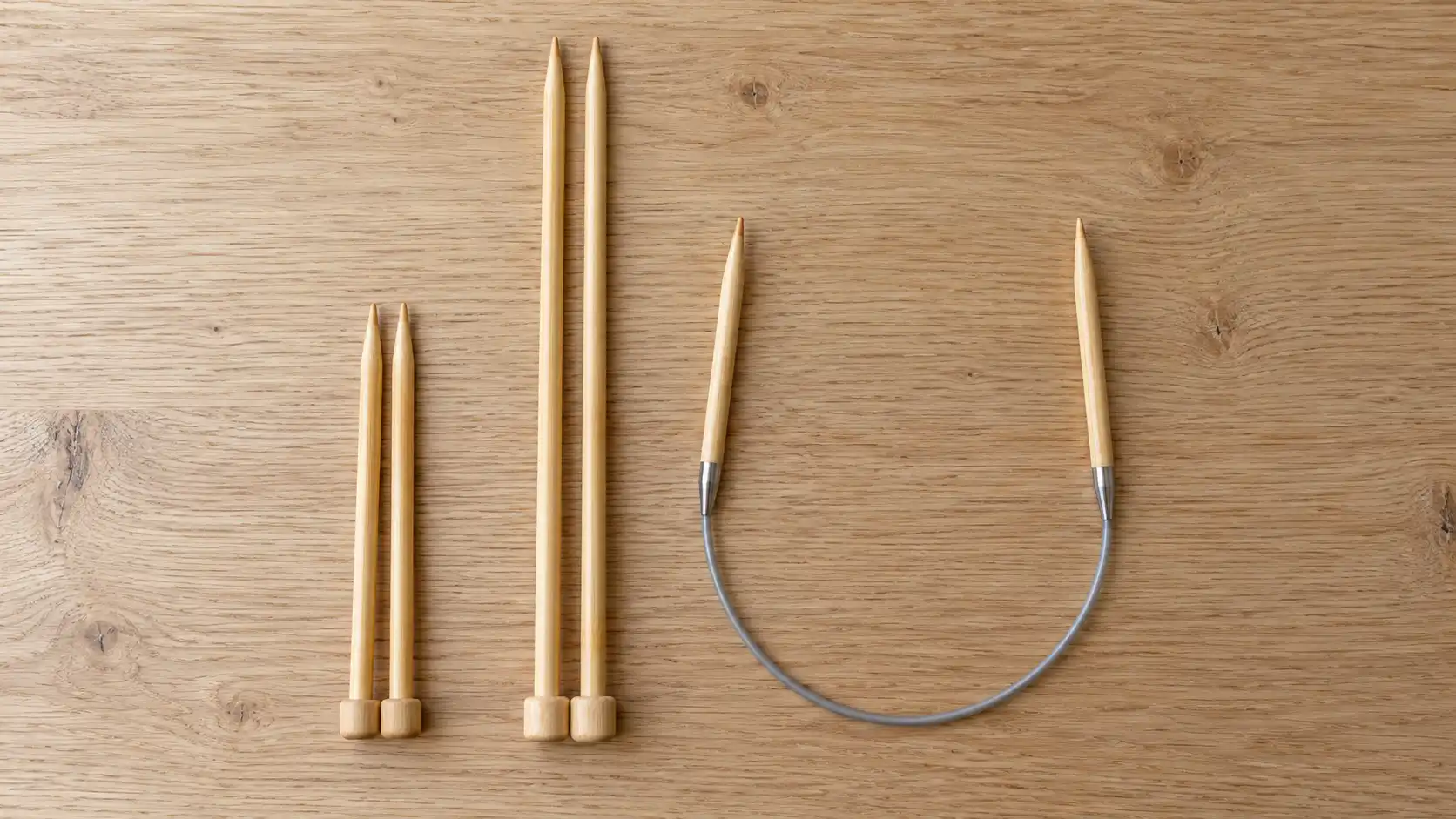
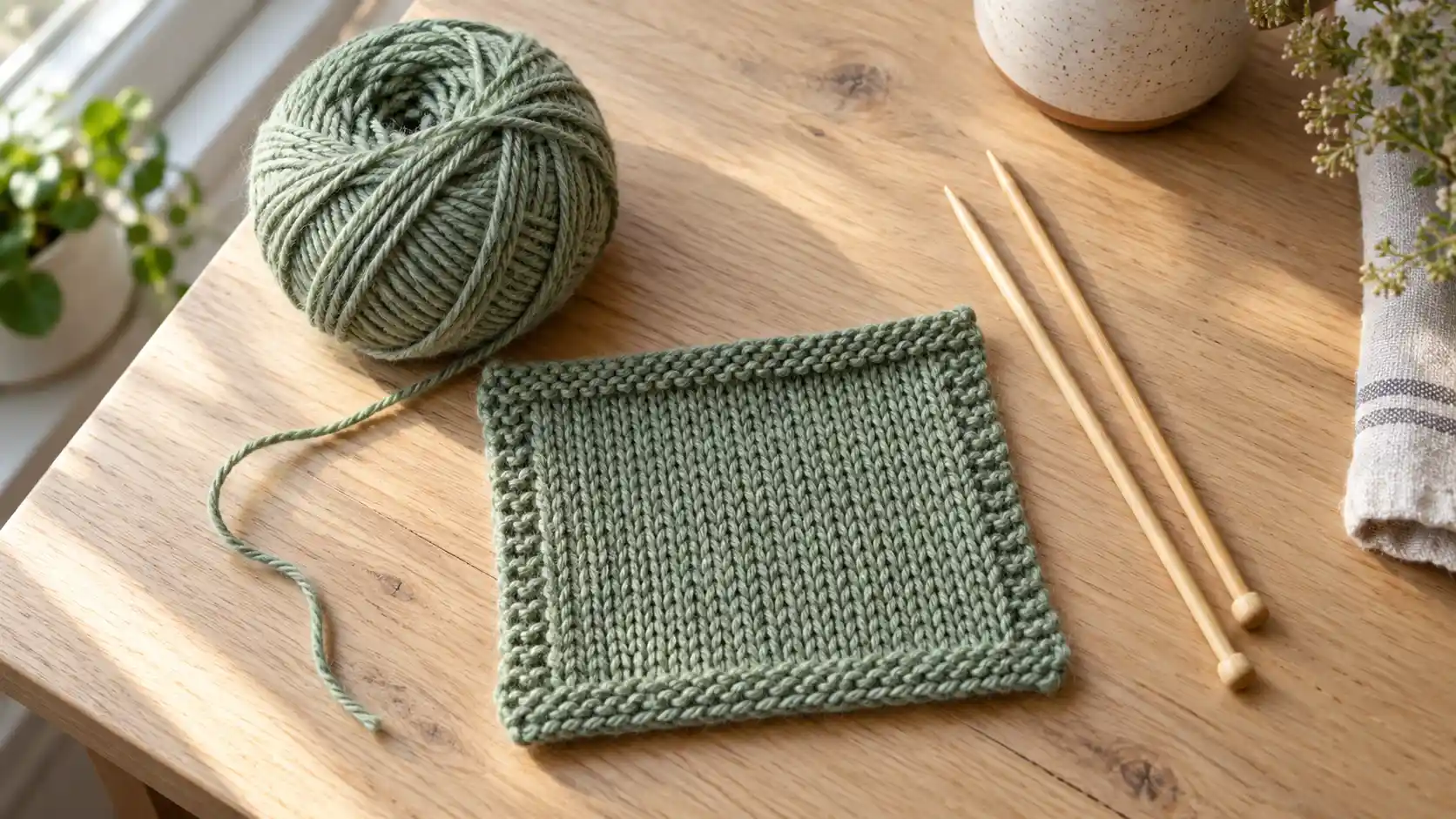
Wondering what size needles for DK yarn will give you the right fabric? If you have a pattern, start with its suggested needle and check the stated gauge. If you are experimenting without a pattern, 4 mm is a sensible first swatch, rather than a rule for every DK yarn.
The useful question is what happens after that first swatch. A different needle may be needed to make a sweater fit, keep a toy’s stuffing covered, or give a scarf enough drape. Here is how to choose, measure and adjust without guessing from the yarn name alone.
What size needles for DK yarn should you try first?
The Craft Yarn Council places DK in its 3 / Light category and gives a general knitting-needle range of 3.75–4.5 mm, with 21–24 stockinette stitches over 4 inches. These are guidelines for the category, not a promise about your knitting. See the Craft Yarn Council’s yarn weight system.
Use the range to choose a starting point. Then make the fabric your project needs.
| Your starting situation | First thing to check | Next step |
|---|---|---|
| Following a fitted pattern | Pattern needle, stitch pattern and gauge | Swatch exactly as instructed |
| Trying a new DK yarn without a pattern | Yarn label’s knitting recommendation | Make a sample, then judge its feel |
| Replacing the pattern’s yarn | Fibre, construction and required gauge | Test the substitute before casting on |
| Holding two strands together | The combined fabric, not either label alone | Make a new swatch for the combination |
For a concrete manufacturer example, Stylecraft Special DK specifies 4 mm needles and 22 stitches by 30 rows over 10 cm / 4 inches. Those figures belong to that yarn’s published specification. They do not mean every DK yarn, or every knitter using it, will produce that result.
Are DK and 8-ply the same thing?
In Australian yarn shopping, 8-ply commonly names the DK weight group. It is a useful starting translation when a UK pattern says DK and an Australian ball band says 8-ply. Australian maker Bendigo Woollen Mills uses 8-ply as a yarn-weight category.
Still compare the actual label and the pattern’s gauge. A regional weight name is not a measurement precise enough to replace a swatch. Nor should you count the visible strands in a modern yarn and assume that number establishes its weight category.
If your main problem is identifying an unfamiliar yarn, use the broader yarn weight guide. This article focuses on choosing needles once DK or 8-ply is your starting point.
Read the pattern before the ball band
A ball band describes the yarn. A pattern describes the fabric used to calculate that particular design.
Suppose the label suggests 4 mm, but the sweater pattern uses 3.75 mm to achieve its gauge. Begin with the pattern’s 3.75 mm recommendation. The designer may be aiming for a firmer fabric than the label’s reference sample.
Also look for separate instructions for ribbing, main fabric and finishing. A smaller ribbing needle is a design choice; it does not mean you should use that needle for the entire garment. Check whether gauge is given in stockinette, a textured stitch, or a colourwork pattern.
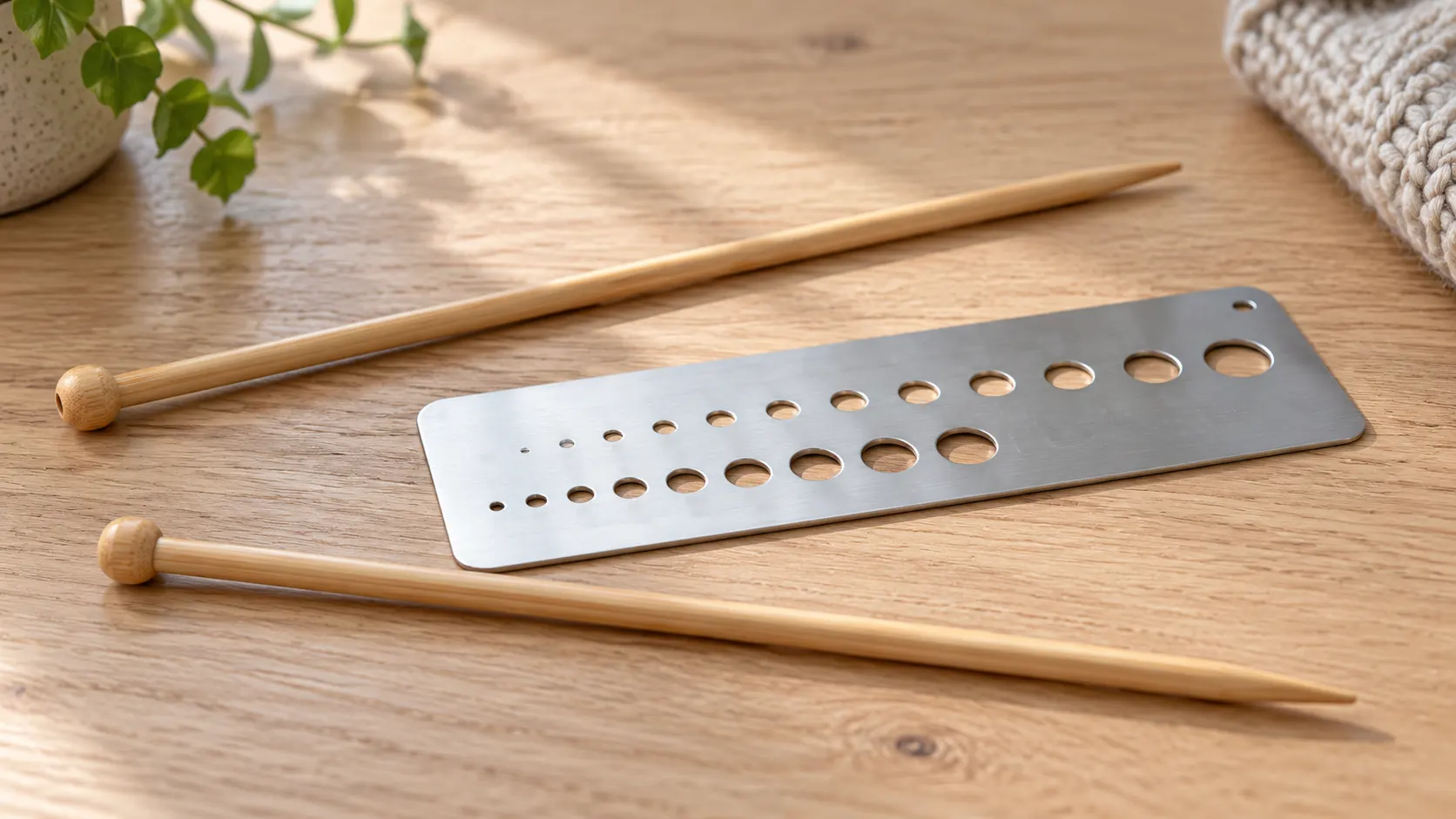
When the pattern gives only a US needle number, look up its millimetre diameter in the knitting needle sizes chart. Avoid converting a US number as though it were an older UK size.
Make a swatch that gives you a useful answer
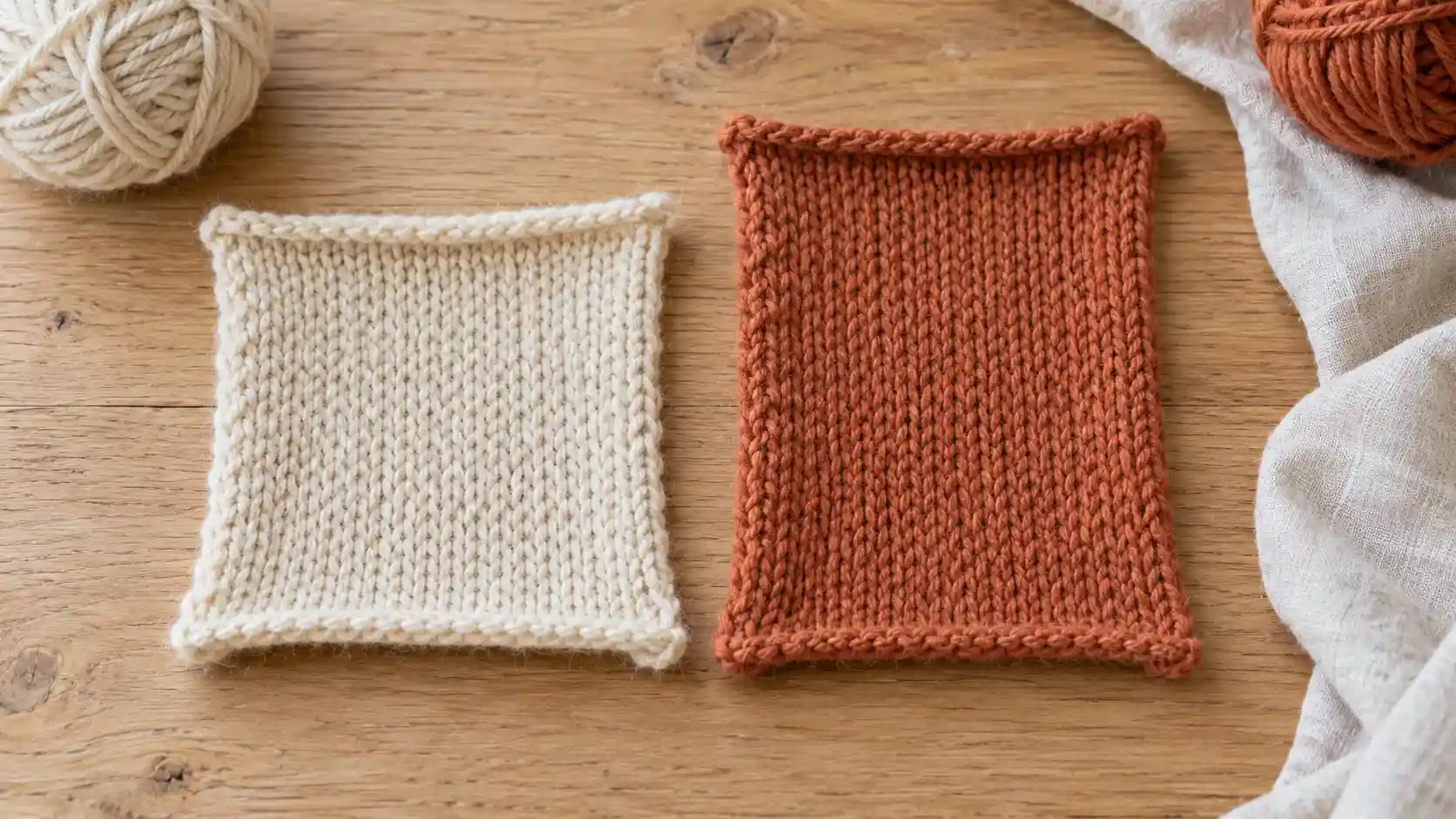
A tiny patch of knitting can be misleading because edge stitches take up much of the sample. Make enough fabric to measure a central area away from the cast-on, sides and needle.
- Use the yarn, needle type and stitch pattern you intend to use for the project.
- Make the sample larger than the area the pattern asks you to measure.
- Wash and dry it according to the yarn’s care instructions and the treatment planned for the finished item.
- Let it dry fully, then place it flat without stretching it into the target size.
- Count both stitches and rows in the central measuring area. Include partial stitches when needed.
- Record the needle diameter and your result before changing anything.
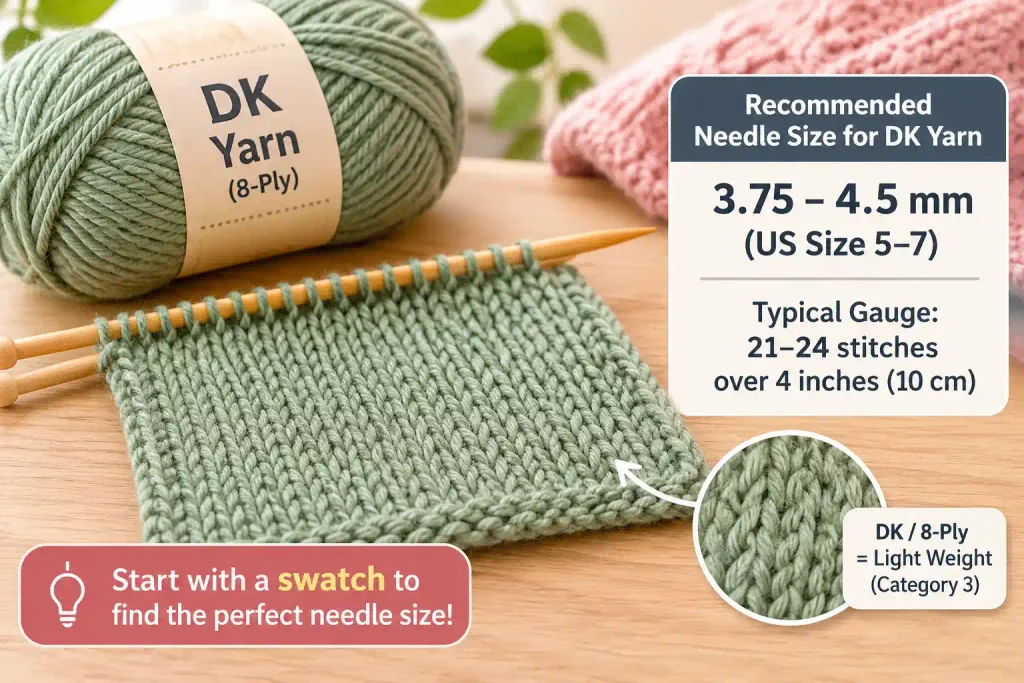
If the garment is knitted in the round, make a representative round swatch. The guide to swatching in the round explains two approaches.
Do not pull the swatch until it matches the pattern and then treat that as the natural gauge. If the instructions call for a particular blocking method, follow it and record what you did.
Adjust the needle from your stitch count
Compare counts over the same distance. A count over 5 cm cannot be compared directly with a target over 10 cm.
| Your washed sample | What that means | Adjustment to try |
|---|---|---|
| More stitches than the target | Your stitches are smaller | Try a larger needle |
| Fewer stitches than the target | Your stitches are larger | Try a smaller needle |
| Stitch count matches, row count differs | Width and height need separate attention | Check the pattern’s shaping and row instructions |
For example, imagine a pattern requires 21–24 stitches over 10 cm, but your sample has 24. At that gauge, a 110-stitch piece would measure about 45.8 cm, rather than the intended 50 cm. That is a hypothetical calculation, not a test of a particular yarn. It shows why a small count difference can matter across a whole garment.
Try the next appropriate needle size, make another sample, and measure again. The gauge calculator can help with stitch-to-measurement calculations once you have your own numbers.
If the stitches match but the rows do not, avoid changing needles automatically and losing the correct stitch gauge. Read what to do when stitch gauge matches but row gauge does not before altering a fitted pattern.
Let the intended fabric guide the final choice
Matching a number is useful, but you also need to like the fabric. Hold the washed sample, fold it and look at it against the light.
For a scarf, ask whether it bends and hangs the way you want. For a sweater, consider whether the fabric feels appropriate at the required gauge. For a stuffed item, follow the pattern’s tighter-fabric instructions and check for gaps.
If your substitute yarn reaches the gauge only by becoming unpleasantly stiff or very open, choose a more suitable yarn. Changing the needle indefinitely will not make every yarn work for every design.
Keep the actual project needles for the final sample. If you change material, brand, or from flat to circular knitting, recheck your gauge rather than assuming the result will stay the same.
Common mistakes with DK needles
- Treating 4 mm as compulsory. It is a starting point when no better instruction is available.
- Using the hook recommendation. A yarn label may show both knitting needles and crochet hooks. Read the correct symbol.
- Skipping the wash. Measure the sample in the condition in which you will use the finished fabric.
- Changing several things at once. Keep the yarn and stitch pattern the same while comparing needle sizes.
- Ignoring the pattern’s measurement unit. Many patterns pair 10 cm and 4 inches as conventions. Follow the actual measuring unit specified; they are not mathematically identical lengths.
Frequently asked questions
Can I knit DK yarn with 4 mm needles?
Yes. It is a reasonable place to begin, and some manufacturers specify it for particular DK yarns. For a fitted project, your washed swatch must still match the pattern’s gauge.
Can I use 3.5 mm or 5 mm needles with DK yarn?
You can make a sample with either. Judge the result for your project rather than assuming it is right because the yarn is DK. Follow the pattern’s instructions when size and shaping depend on gauge.
What size knitting needles should I use for 8-ply wool in Australia?
Read the 8-ply yarn’s label and your pattern first. A DK starting point such as 4 mm can be useful for an exploratory sample, but the gauge and fabric decide the final needle.
Does double knitting yarn mean knitting with two strands?
No. DK is a yarn-weight name. The technique called double knitting and the act of holding two yarn strands together are separate things.
Does a 4 mm needle prove my unlabelled yarn is DK?
No. You can put many yarns on a 4 mm needle. Needle choice alone cannot identify an unknown yarn’s thickness, fibre or original specification.
Should I use the same needle for the ribbing?
Use the needle listed for that part of the pattern. If it gives a separate ribbing needle, switch when instructed and use the main-fabric needle for the relevant gauge sample.
Keep a simple swatch record
Write down the yarn name, colour, needle diameter, needle type, stitch pattern, washing method, stitch gauge and row gauge. A note beside the sample is much more useful than trying to remember which needles you used three projects ago.