
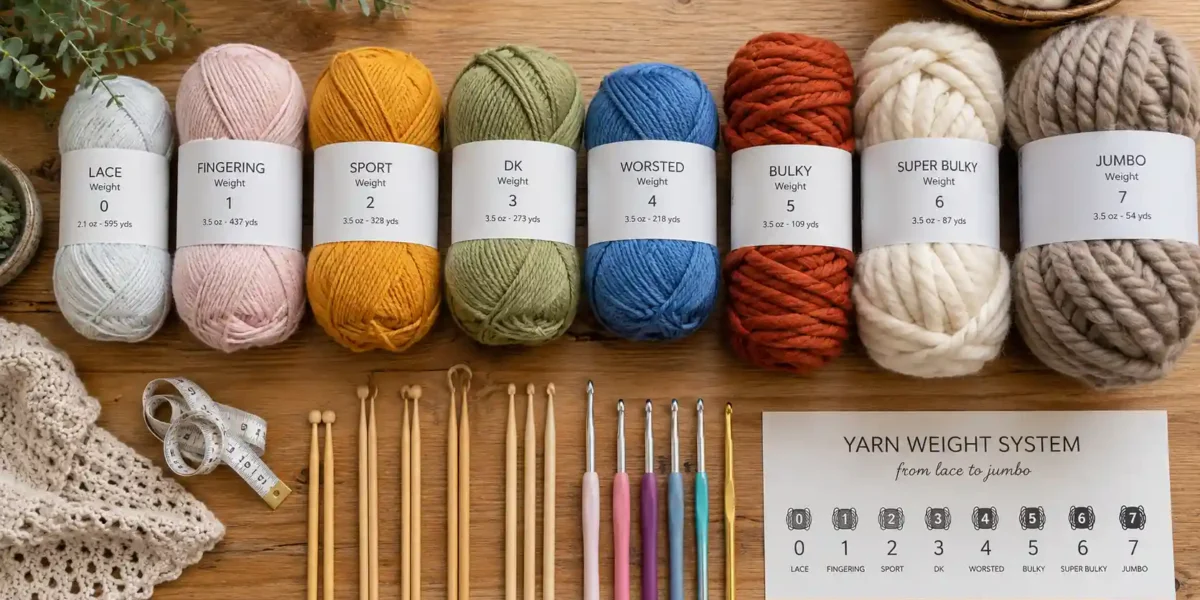
Yarn Weight Guide: How to Tell Yarn Weight Using a Yarn Weights Chart
Introduction
Picture this: you fall in love with a gorgeous knitting pattern online, rush to the craft store, grab a yarn that looks about right, and cast on excitedly only to end up with a scarf the size of a blanket or a hat so tiny it would fit a doll. Sound familiar?
This is the most common frustration beginner knitters and crocheters face, and almost every time, yarn weight is the culprit. Choosing the wrong yarn thickness can completely change your project’s size, drape, stitch definition, and texture even when you follow every other instruction perfectly.
This yarn weight guide will walk you through every yarn category, from delicate lace to chunky jumbo, with clear charts, real-world project examples, and practical tips that work whether you’re knitting or crocheting. By the time you finish reading, choosing the right yarn will feel like second nature not a guessing game.
Quick Answer: Yarn weight refers to the thickness of a yarn strand. Thicker yarn knits up faster and creates chunkier fabric; finer yarn creates more delicate, detailed fabric. There are 8 standard yarn weight categories, each with its own recommended needle size, hook size, and best uses.
What Is Yarn Weight?
Despite the name, yarn weight has almost nothing to do with how much a skein weighs on a scale. Instead, yarn weight describes how thick or thin a strand of yarn is. A thicker strand creates a denser, heavier fabric; a thinner strand produces something more lightweight and delicate.
Think of it like pasta: spaghetti and fettuccine are both pasta, but they cook differently, pair with different sauces, and give you a completely different experience on the plate. Yarn weight works the same way the “thickness” of your yarn determines everything from the needle size you’ll need to how long your project will take to finish.
Why Yarn Thickness Matters
Here’s what yarn weight directly controls:
- Gauge — how many stitches and rows fit into a given measurement (usually 4 inches)
- Drape — whether the finished fabric flows softly or holds its structure
- Warmth — thicker yarn traps more air and creates warmer fabric
- Stitch definition — finer yarns show intricate stitch patterns more clearly
- Project speed — heavier yarn knits up much faster than lace weight
When a pattern says “worsted weight yarn,” it’s telling you the specific thickness needed to match the gauge the designer used. Substitute a different weight without adjusting your needle size, and your project dimensions will be off sometimes dramatically.
Beginner Tip: Always check the yarn weight before buying. It’s listed on the ball band (the paper wrapper around your yarn) and usually shown with a skein symbol and a number from 0 to 7.
Yarn Weight & Gauge Calculator
Use the GaugeGenie yarn calculator to understand how yarn weight affects your gauge before you cast on. Avoid sizing mistakes, save yarn, and knit with confidence.
Complete Yarn Weight Chart
This is the main reference table you’ll want to bookmark. It covers all eight standard yarn weight categories as defined by the Craft Yarn Council, the leading standards body for the yarn industry.
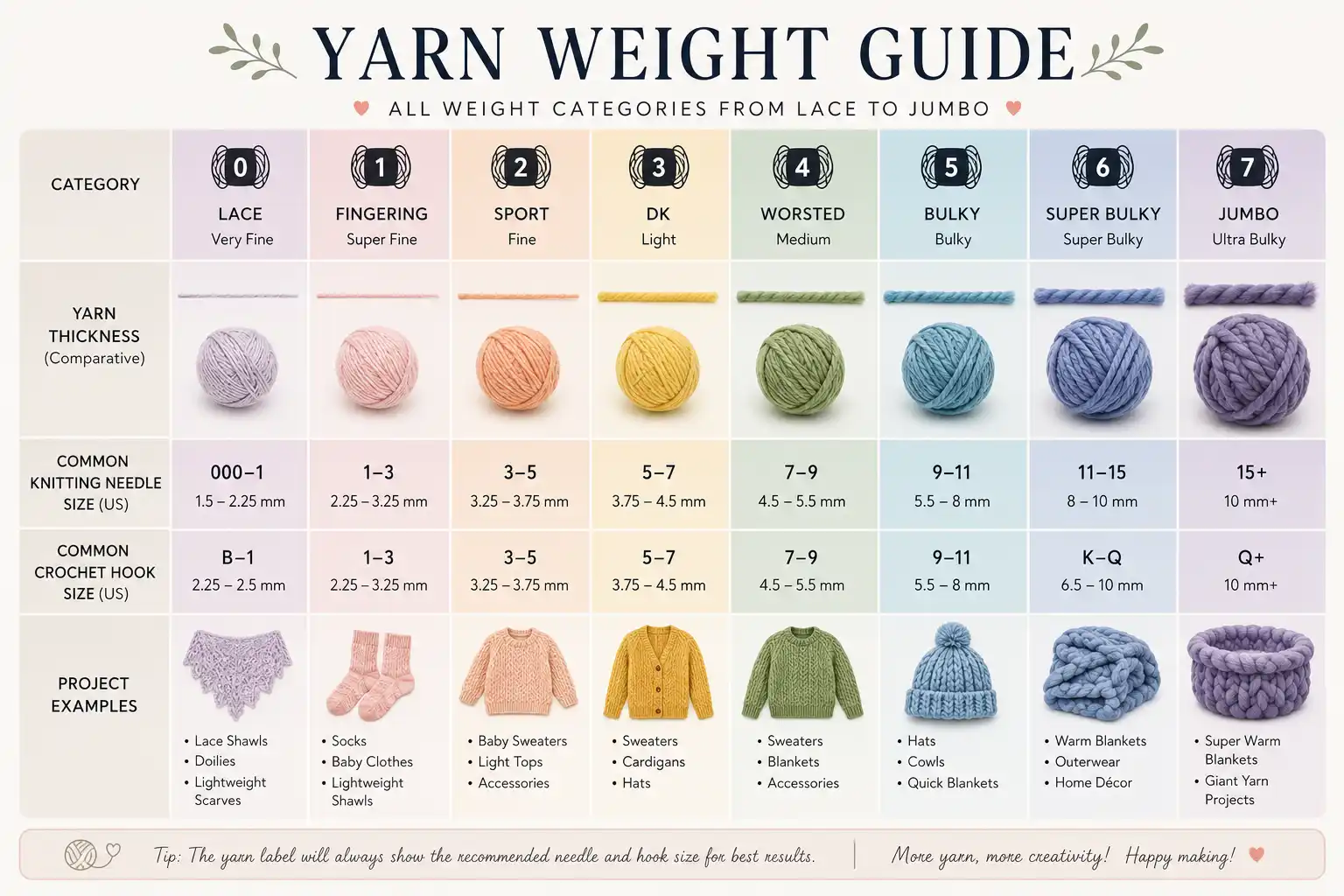
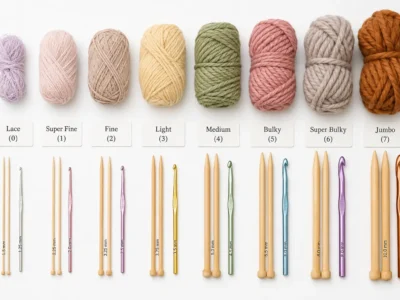
| # | Category Name | Also Called | Ply Equivalent | WPI (Wraps Per Inch) | Knitting Needle (mm) | Crochet Hook (mm) | Common Projects |
|---|---|---|---|---|---|---|---|
| 0 | Lace | Cobweb, Thread | 1–2 ply | 30–40+ | 1.5–2.25 mm | 1.6–2.25 mm (steel) | Shawlettes, lace doilies, lightweight wraps |
| 1 | Super Fine | Fingering, Sock | 3–4 ply | 14–30 | 2.25–3.25 mm | 2.25–3.5 mm | Socks, baby items, fine shawls |
| 2 | Fine | Sport, Baby | 5 ply | 12–18 | 3.25–3.75 mm | 3.5–4.5 mm | Baby garments, light cardigans, socks |
| 3 | Light | DK, Light Worsted | 8 ply | 11–15 | 3.75–4.5 mm | 4.5–5.5 mm | Light sweaters, scarves, hats |
| 4 | Medium | Worsted, Aran | 10 ply | 9–12 | 4.5–5.5 mm | 5.5–6.5 mm | Sweaters, blankets, hats, scarves, bags |
| 5 | Bulky | Chunky | 12 ply | 6–9 | 5.5–8 mm | 6.5–9 mm | Quick scarves, hats, home décor |
| 6 | Super Bulky | Roving, Thick-and-Thin | — | 4–6 | 8–12.75 mm | 9–15 mm | Arm knitting, thick cowls, chunky blankets |
| 7 | Jumbo | Mega Bulky | — | <4 | 12.75 mm+ | 15 mm+ | Extreme knitting, statement throws |
How to use this table: Find your yarn’s category number (printed on the label), then read across for needle recommendations and project ideas. If you’re substituting yarn, match the WPI (wraps per inch) for the closest thickness match.
The WPI measurement is one of the most reliable ways to identify mystery yarn without a label. Wrap the yarn around a ruler for one inch without overlapping or stretching count the wraps. Match that number to the chart above.
Mystery Yarn Test Example
We wrapped three unlabeled yarn samples around a ruler using the WPI method:
• Sample A: 32 wraps → Lace weight
• Sample B: 11 wraps → DK / Light weight
• Sample C: 7 wraps → Bulky weight
The WPI method proved far more reliable than visually guessing thickness, especially when comparing unfamiliar brands.
How We Tested Different Yarn Weights
To create this guide, we compared swatches across multiple yarn categories using manufacturer-recommended needle sizes and measured stitch counts before and after blocking. We tested yarn weights from lace through super bulky to understand how thickness changes gauge, drape, stitch definition, and project speed.
A few patterns emerged quickly:
• Lace and fingering yarns showed the biggest gauge changes after blocking
• DK and worsted produced the most consistent swatches across different needle materials
• Bulky and super bulky weights magnified small tension differences much faster than expected
These tests reinforced something experienced knitters already know: yarn weight affects far more than project size — it changes the entire feel of your fabric.
Yarn Weight Categories Explained One by One
Let’s go deeper into each weight category. Understanding the personality of each yarn type will help you choose the right one instinctively not just by reading a label.
Weight 0 — Lace
Thickness: Extremely fine, almost thread-like
Feel: Delicate, whisper-light, sometimes wiry depending on fiber
Best For: Lace shawls, intricate doilies, summer wraps, heirloom projects
Needles: 1.5–2.25 mm | Hooks: Steel crochet hooks, 0.75–2.25 mm
Lace weight is the finest category in the yarn weight chart. If you’ve ever admired a shawl so delicate it looks like a spider web, it was almost certainly made with lace weight yarn. These projects take patience and a keen eye, but the results are genuinely breathtaking.
Pros: Creates the most intricate, lightweight fabric possible
Cons: Slow to work up; requires focus and good lighting
Beginner Friendliness: ⭐ best attempted after you’re comfortable with basic stitches
Seasonal Use: Spring and summer, or as year-round decorative items
Fiber Recommendations: Merino/silk blends, alpaca, mohair
Weight 1 — Super Fine (Fingering / Sock)
Thickness: Very fine, slightly thicker than lace
Feel: Smooth, lightweight, often slightly springy
Best For: Socks, baby booties, fine shawls, delicate accessories
Needles: 2.25–3.25 mm | Hooks: 2.25–3.5 mm
Fingering weight also called sock yarn is where a lot of dedicated knitters and crocheters live. It’s particularly beloved for sock knitting because the fine gauge creates durable, close-fitting fabric that wears well inside shoes. Many beautiful gradient yarns come in fingering weight, making this a favorite for colorwork shawls.
Pros: Incredible stitch definition; excellent for complex color patterns
Cons: Projects take more time; tiny needles can cause hand fatigue for beginners
Beginner Friendliness: ⭐⭐ manageable once you’ve worked with slightly heavier yarn first
Seasonal Use: Year-round; light enough for warmer months
Fiber Recommendations: Merino, superwash wool, cotton/nylon blends
Weight 2 — Fine (Sport / Baby)
Thickness: Fine but noticeably thicker than fingering
Feel: Smooth, soft, slightly more substantial
Best For: Baby garments, lightweight cardigans, ankle socks, accessories
Needles: 3.25–3.75 mm | Hooks: 3.5–4.5 mm
Sport weight yarn is an underrated middle ground finer than DK but faster to work than fingering. It’s especially popular for baby items where you want a soft drape without the project taking months to complete. Many lightweight adult sweaters are also designed for sport weight.
Pros: Great stitch definition; projects complete faster than fingering
Cons: Still requires patience; less common in shops than worsted or DK
Beginner Friendliness: ⭐⭐⭐ accessible for beginners with some experience
Seasonal Use: Spring, autumn, year-round baby items
Fiber Recommendations: Merino, cotton, bamboo blends
Weight 3 — Light (DK / Light Worsted)
Thickness: Medium-light; noticeably thicker than sport
Feel: Soft, slightly drapey, versatile
Best For: Sweaters, hats, scarves, lightweight blankets, shawls
Needles: 3.75–4.5 mm | Hooks: 4.5–5.5 mm
DK (double knitting) weight is enormously popular in Europe and growing in the US. It knits up faster than sport or fingering while still producing a refined, somewhat lightweight fabric. If worsted feels a bit too thick for a garment you have in mind, DK is often the perfect answer.
Pros: Versatile; great for garments; faster than sport weight
Cons: Slightly harder to find in US big-box craft stores
Beginner Friendliness: ⭐⭐⭐⭐ excellent for beginners who’ve learned the basics
Seasonal Use: Three-season: autumn through spring
Fiber Recommendations: Superwash merino, cotton, cotton/acrylic blends
Weight 4 — Medium (Worsted / Aran)
Thickness: The “standard” yarn medium weight, well-rounded
Feel: Substantial, warm, easy to handle
Best For: Sweaters, hats, mittens, scarves, blankets, bags, amigurumi
Needles: 4.5–5.5 mm | Hooks: 5.5–6.5 mm
Worsted weight is the most widely used yarn weight in North America and for good reason. It’s the sweet spot between speed and stitch definition, easy to hold, and works well for nearly every project type imaginable. Most beginners are taught on worsted weight because the stitches are clearly visible and the needles are comfortable to hold.
Pros: Fast to work up; widely available; beginner-friendly; huge variety of patterns
Cons: Can feel too warm for summer garments
Beginner Friendliness: ⭐⭐⭐⭐⭐ the gold standard for learning
Seasonal Use: Autumn and winter primarily; can work for home décor year-round
Fiber Recommendations: Acrylic, merino wool, cotton, wool blends
Weight 5 — Bulky (Chunky)
Thickness: Noticeably chunky; creates a cozy, textured look
Feel: Thick, warm, rustic or smooth depending on fiber
Best For: Hats, scarves, cowls, quick blankets, cushion covers
Needles: 5.5–8 mm | Hooks: 6.5–9 mm
Bulky yarn is where projects start to feel satisfyingly fast. A simple ribbed hat in bulky yarn can be completed in an evening session perfect for gift-giving in a pinch. The larger stitches also make texture patterns like cables or seed stitch really pop visually.
Pros: Very fast to knit or crochet; satisfying for beginners; great for gifts
Cons: Fewer garment patterns available; can feel too hot for layering
Beginner Friendliness: ⭐⭐⭐⭐⭐ instant gratification for new crafters
Seasonal Use: Winter and early spring
Fiber Recommendations: Wool, acrylic, wool/alpaca blends
Weight 6 — Super Bulky
Thickness: Very thick; chunky statement-maker
Feel: Squishy, voluminous, extremely warm
Best For: Arm-knitting, thick cowls, chunky blankets, wall hangings
Needles: 8–12.75 mm | Hooks: 9–15 mm
Super bulky yarn is the choice when you want maximum visual impact and quick results. Chunky blankets made from super bulky yarn have dominated home décor trends for years, and arm-knitting (literally using your arms as the needles) became a viral sensation thanks to this weight category.
Pros: Extremely fast; beginner-friendly; dramatic visual results
Cons: Projects can feel stiff; limited to simpler stitch patterns
Beginner Friendliness: ⭐⭐⭐⭐ great for simple patterns
Seasonal Use: Winter; home décor year-round
Fiber Recommendations: Merino roving, chenille, thick acrylic
Weight 7 — Jumbo (Mega Bulky)
Thickness: Extreme; finger-thick or larger strands
Feel: Cloud-like or very dense depending on fiber
Best For: Statement throws, extreme knitting installations, décor
Needles: 12.75 mm+ (or your hands) | Hooks: 15 mm+
Jumbo is the most theatrical category in the yarn thickness guide. Projects work up in minutes rather than hours, and the oversized aesthetic is undeniably striking. While it’s not suited for wearable garments, jumbo yarn creates genuinely show-stopping home décor pieces.
Pros: Fastest possible knitting/crocheting experience
Cons: Limited pattern options; expensive per skein; not suitable for most clothing
Beginner Friendliness: ⭐⭐⭐ simple stitches only
Seasonal Use: Winter; home décor year-round
Fiber Recommendations: Chunky merino roving, thick chenille
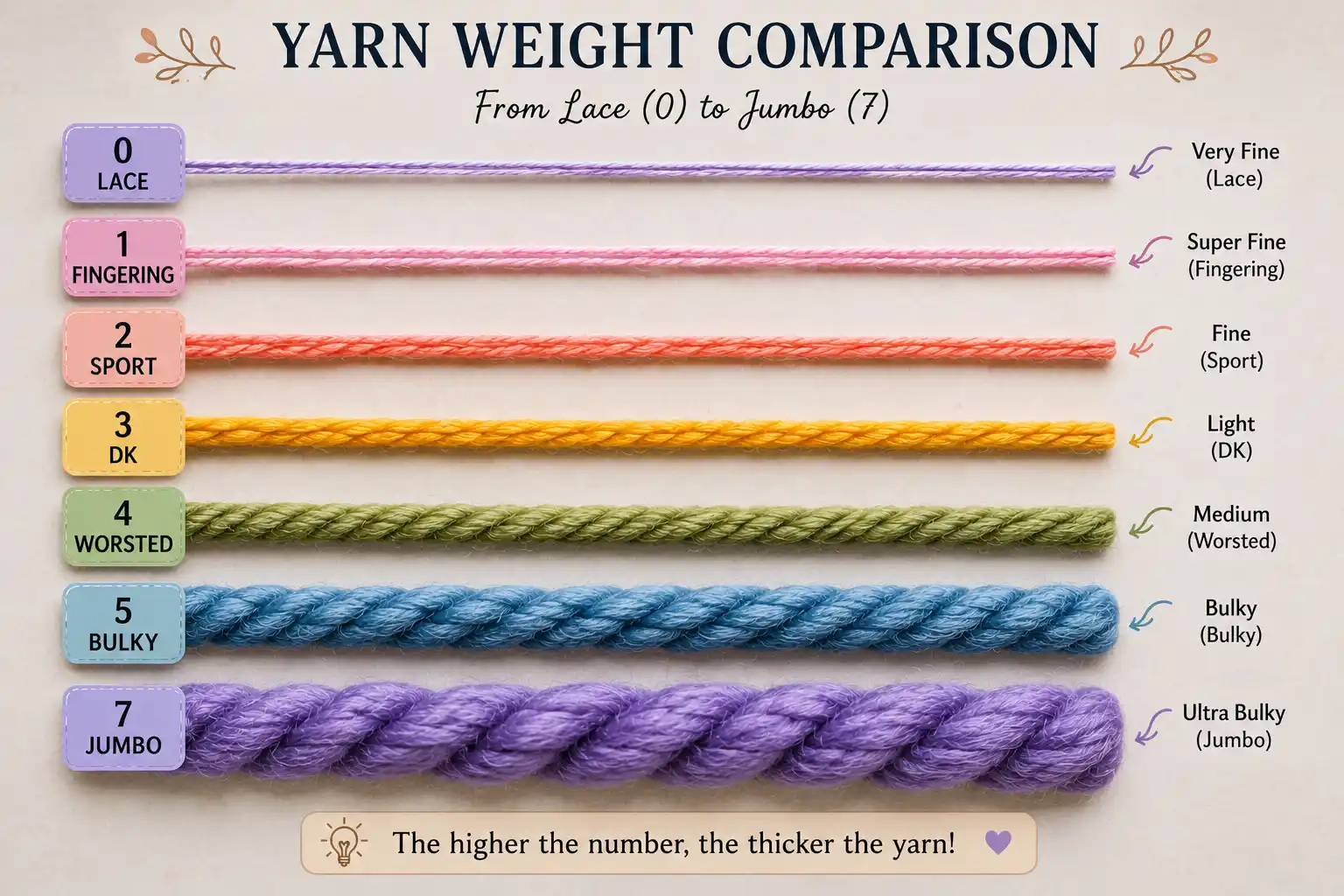
Yarn Weight Symbols Explained
Walk into any yarn store and pick up a skein somewhere on the label, you’ll find a small skein icon with a number inside it. That number is the standardized yarn weight symbol created by the Craft Yarn Council.
The Standard Yarn Weight Symbol System
The Craft Yarn Council introduced this universal symbol system to help crafters quickly identify yarn thickness no matter what brand they’re buying or what country the yarn comes from. Here’s what each number means:
| Symbol Number | Weight Name | Description |
|---|---|---|
| 0 | Lace | Thread-like; finest weight |
| 1 | Super Fine | Fingering/sock weight |
| 2 | Fine | Sport/baby weight |
| 3 | Light | DK/light worsted |
| 4 | Medium | Worsted/aran |
| 5 | Bulky | Chunky |
| 6 | Super Bulky | Extra chunky |
| 7 | Jumbo | Mega bulky |
How to Read the Symbol on Your Label
Look for the yarn skein icon it’s usually a small oval or skein shape. The number inside tells you the weight category. If you see a 4 inside that symbol, you’re holding a medium/worsted weight yarn.
⚠️ Beginner Warning: Some yarn labels especially from smaller indie dyers may not include the Craft Yarn Council symbol. In these cases, check the label for needle size recommendations and cross-reference them with the yarn weight chart above. The suggested needle size is your most reliable clue.
Common Label Mistakes Beginners Make
- Ignoring the symbol entirely — glancing at the label only for color name and price
- Confusing fiber content with weight — “merino” is a fiber, not a weight category
- Assuming “bulky” means all thick yarns — bulky is a specific category (weight 5), while super bulky and jumbo are separate
- Overlooking the recommended gauge — this is the most precise indicator of how the yarn will behave
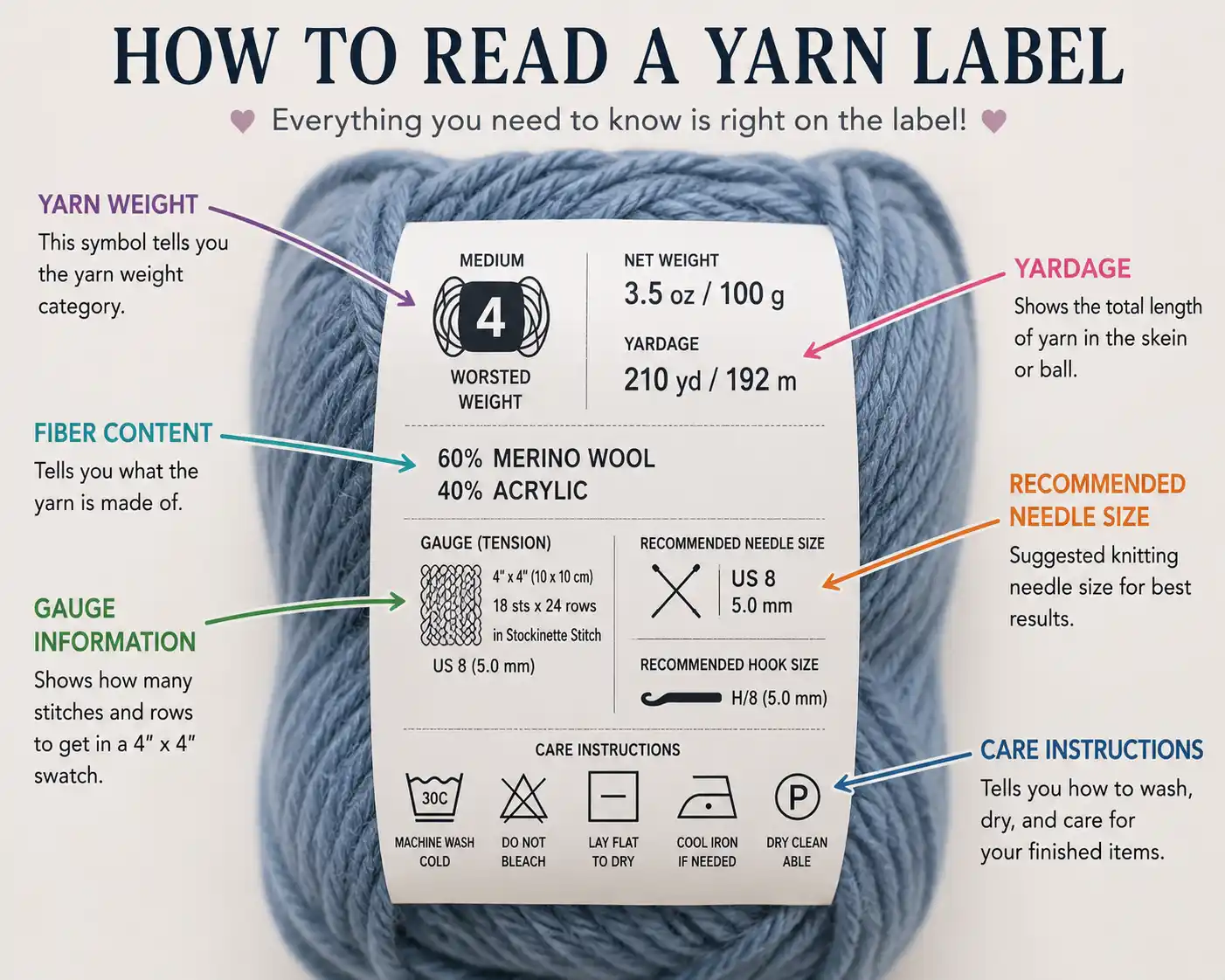
Reading yarn labels correctly becomes easier when you understand official yarn symbols and care icons used by manufacturers.
Yarn Weight vs Ply — What’s the Difference?
This is one of the most frequently misunderstood topics in yarn shopping especially for anyone who’s bought yarn in multiple countries. The short answer: ply and yarn weight are not the same thing, and confusing them leads to disappointing results.
What Is Ply?
Ply refers to the number of individual strands twisted together to create a single yarn. A 2-ply yarn has two strands twisted together; a 4-ply has four. In theory, more plies = thicker yarn but this only holds true when comparing yarns made with similarly-spun individual strands.
Here’s the catch: manufacturers can spin each individual strand (called a “single”) at dramatically different thicknesses. Two yarns can both be labeled “4-ply” but be completely different thicknesses if their singles were spun differently.
UK vs US Yarn Naming Confusion
This is where it gets genuinely tricky for anyone shopping across borders:
| UK Name | US Equivalent | Notes |
|---|---|---|
| 2-ply | Lace weight | Very fine |
| 3-ply | Fingering | Still quite fine |
| 4-ply | Fingering/Super Fine | Common UK sock yarn label |
| DK (8-ply) | DK / Light Worsted | This one matches well! |
| Aran (10-ply) | Worsted | Common source of confusion |
| Chunky (12-ply) | Bulky | Roughly equivalent |
Expert Note: In the UK, “4-ply” is a very common yarn label but it describes what Americans would call fingering or super-fine weight, not four twisted strands in the way the word “ply” might imply. Always check the recommended needle size on the label rather than relying on the ply number alone.
Why Yarn Weight Matters More Than Ply Today
Modern yarn standards have largely moved away from ply as a meaningful descriptor. The Craft Yarn Council’s number system (0–7) is now the most reliable universal guide, because it’s based on actual gauge and thickness, not strand construction. When substituting yarn or following any pattern written after the mid-2000s, always work from the weight category, not the ply label.
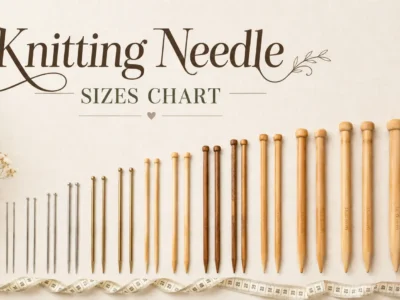
Knitting Needle Conversion Chart & Converter
Use the GaugeGenie needle converter to cross-reference knitting needle sizes across US, UK, metric, and international systems. It’s especially useful when working with vintage patterns or older knitting instructions where sizing systems can be confusing.
Best Yarn Weight for Beginners
If you’re just starting out, the single most important decision you’ll make is choosing a forgiving yarn weight one that won’t fight you while you’re still learning to control your tension.
The Winner: Worsted Weight (Category 4)
Worsted weight yarn earns its beginner-friendly reputation for several reasons:
- The stitches are clearly visible, making it easy to identify and fix mistakes
- 4.5–5.5 mm needles or hooks are comfortable to grip for extended sessions
- Projects complete at a satisfying pace — a basic hat can be done in one evening
- It’s the most widely available weight at craft stores globally
- The largest selection of beginner patterns are written for worsted weight
Quick Recommendations for First Purchases
| Goal | Recommended Weight | Why |
|---|---|---|
| Learning basic stitches | Worsted (4) | Stitches are clearly visible |
| First scarf | Worsted (4) or Bulky (5) | Fast results, confidence-building |
| First hat | Worsted (4) | Easy shaping, quick finish |
| First baby item | Sport (2) or DK (3) | Lightweight for babies |
| Quick gift in a weekend | Bulky (5) | Fastest projects |
| Goal | Best Weight | Difficulty | Speed |
|---|---|---|---|
| First Scarf | Worsted | Easy | Medium |
| Fast Gift | Bulky | Easy | Fast |
| Socks | Fingering | Hard | Slow |
| Sweater | DK / Worsted | Medium | Medium |
| Baby Blanket | DK | Easy | Medium |
Yarn Textures Beginners Should Avoid (At First)
- Fuzzy mohair or angora — the halo obscures your stitches, making mistakes nearly invisible until it’s too late
- Very slippery silk or bamboo — stitches slide off needles easily, increasing frustration
- Extremely splitty multi-ply yarns — splitting the plies mid-stitch is discouraging for beginners
- Dark colors — they make it hard to see your stitches; start with medium tones or heather grays
Beginner Tip: Your first yarn doesn’t need to be expensive or “special.” A smooth, medium-colored, worsted weight acrylic is honestly your best teacher. Save the hand-dyed merino for when you know you’ll love what you’re making.
Yarn Weight and Needle Size Relationship
Your needle or hook size is not just a recommendation it’s a critical variable in the equation that produces the right gauge. Understanding how they interact is one of the most empowering skills you can develop as a crafter.
How Needle Size Changes Your Fabric
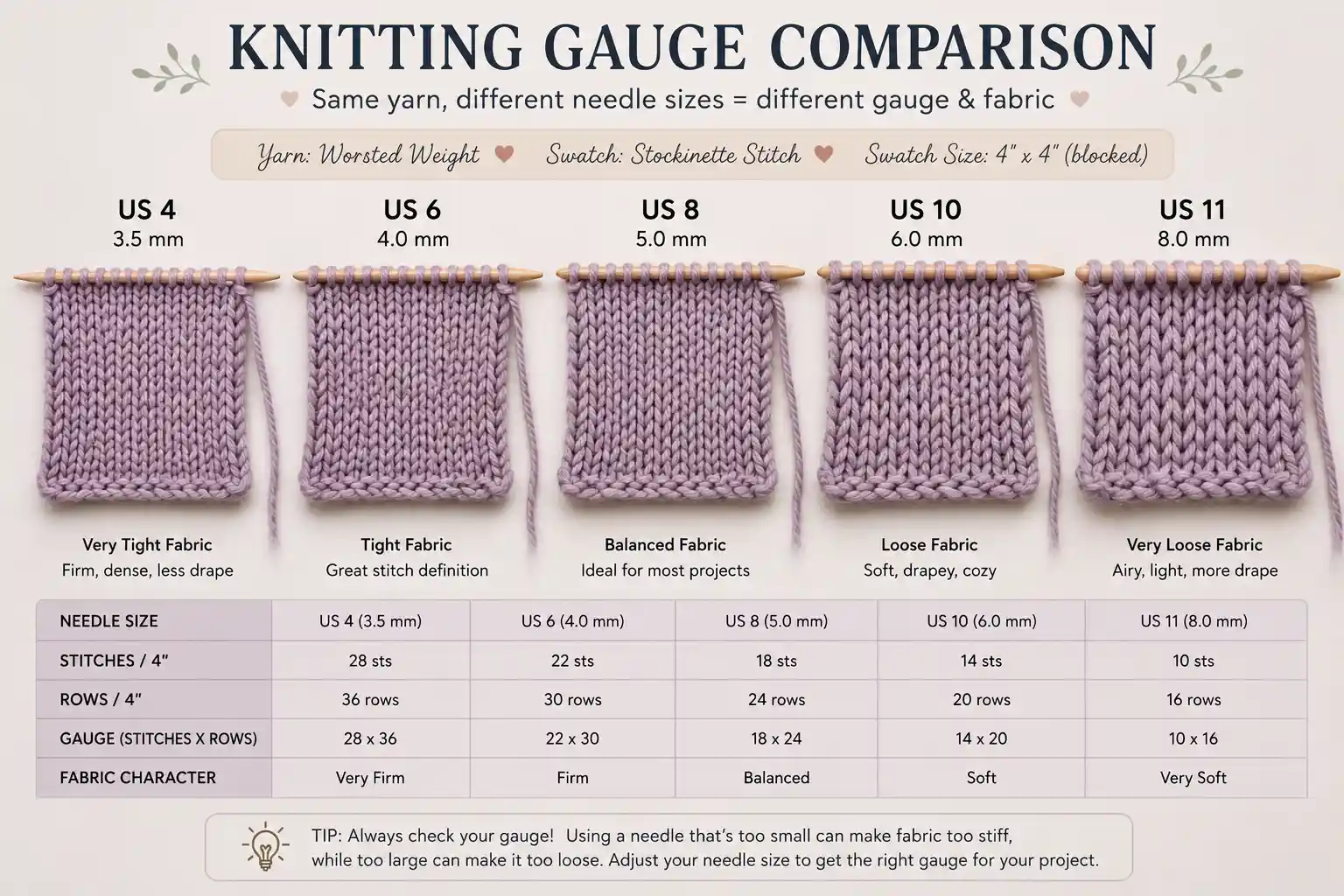
Imagine knitting a swatch with worsted weight yarn on 4.5 mm needles, then another swatch with the same yarn on 6 mm needles. The second swatch will be noticeably larger, more open, and drapier. The yarn hasn’t changed only the needle size.
- Smaller needles → tighter stitches → denser, stiffer fabric → smaller finished dimensions
- Larger needles → looser stitches → more open, drapier fabric → larger finished dimensions
This is why gauge swatching matters so much. A gauge swatch is a small test piece (usually 4×4 inches) that tells you whether your tension matches the pattern designer’s tension. If it doesn’t, you adjust your needle size not your yarn.
The Gauge Basics
Most patterns specify gauge as something like: “18 sts × 24 rows = 4 inches in stockinette on 5 mm needles.” This means:
- Cast on at least 24 stitches
- Knit about 28 rows
- Measure the center 4 inches
- Count stitches and rows
If you have more stitches than the pattern says, go up a needle size. If you have fewer stitches, go down a needle size.
Knitting Gauge Calculator
Already measured your swatch? Use the GaugeGenie gauge calculator to automatically calculate how many stitches to cast on based on your personal gauge. Skip manual math, reduce sizing mistakes, and get more accurate project results.
Crochet Hook Relationship
The same principle applies in crochet. A pattern may specify a 5.5 mm hook for worsted weight, but if your tension runs loose, you might achieve the correct gauge with a 5 mm hook. Swatching before starting any sized project (garments especially) is always worthwhile.
Expert Crafting Note: For scarves and dishcloths, gauge matters less. For sweaters, socks, and hats gauge is everything. Don’t skip the swatch.
Yarn Substitution Guide
Patterns don’t always specify a particular yarn or your perfect yarn might be discontinued or outside your budget. Substituting yarn correctly is an essential skill, and it’s not as intimidating as it sounds once you know the rules.
The Yarn Substitution Rules
Rule 1: Match weight category first. If the pattern calls for DK weight, look for another DK weight yarn. Using worsted weight instead will throw off every measurement in the pattern.
Rule 2: Check gauge. Even within the same weight category, yarns can behave differently. Always swatch your substitute yarn at the recommended needle size before committing.
Rule 3: Consider fiber compatibility. Swapping a wool yarn for an acrylic alternative is usually fine for basic projects. But for patterns that rely on blocking (gently stretching the wet fabric to shape), wool-based yarns respond far better than synthetics. Cotton and acrylic have very little elasticity; wool is forgiving and springy.
Rule 4: Calculate yardage. A pattern requires a specific yardage, not a specific number of skeins. Before purchasing your substitute:
- Note the total yards required in the pattern
- Check the yardage per skein on your substitute yarn
- Divide: total yards needed ÷ yards per skein = number of skeins to buy
- Round up — always buy one extra skein as insurance
Common Substitution Mistakes
| Mistake | Why It’s a Problem | Fix |
|---|---|---|
| Substituting by skein weight (grams), not yardage | Different yarns have very different yards per gram | Always compare yards/meters |
| Swapping cotton for wool in a stranded colorwork pattern | Cotton is inelastic and won’t bloom the same way | Stick to the same fiber family for colorwork |
| Using a fuzzy yarn where crisp stitch definition matters | Cables and lace disappear in halo yarns | Use smooth yarns for textured stitch patterns |
| Ignoring ply structure for sock patterns | Sock yarn needs durability; single-ply breaks down faster | Use multi-ply for high-wear projects |
Common Yarn Weight Mistakes Beginners Make
Even experienced crafters occasionally stumble on yarn weight choices. Here are the most common pitfalls and how to avoid them before they derail your project.
❌ Mistake 1: Choosing the Wrong Weight for the Pattern
The problem: The project looks nothing like the pattern photo it’s either too big, too small, too stiff, or too flimsy.
The fix: Always read the yarn requirements carefully before buying. The weight category listed in the pattern is non-negotiable unless you’re prepared to do some math.
❌ Mistake 2: Ignoring Gauge
The problem: A hat that should fit an adult comes out large enough for a giant or too small to pull over a child’s head.
The fix: Swatch every time. It takes 20 minutes and saves hours of rework. Use the how to check knitting gauge guide if you’ve never swatched before.
❌ Mistake 3: Using the Wrong Hook or Needle Size
The problem: Even with the right yarn weight, the fabric feels wrong too stiff and dense, or too loose and holey.
The fix: The label’s recommended needle size is a starting point, not a law. Adjust based on your personal tension and always aim to match the pattern’s gauge. The needle size calculator at GaugeGenie can help you figure out which adjustment to make.
❌ Mistake 4: Confusing Ply With Weight
The problem: You buy a “4-ply” yarn at a UK shop expecting it to be the same as a US worsted, and end up with something far too fine for your pattern.
The fix: Ignore ply labels. Focus on the needle size recommendation and the yarn weight symbol number. These are consistent globally.
❌ Mistake 5: Mixing Incompatible Fibers in One Project
The problem: You run out of one skein and substitute a different brand from the same weight category but the finished piece has visible texture differences and one section stretches differently than the other.
The fix: Buy all your yarn for one project at the same time, from the same dye lot. Check the dye lot number on the label two skeins of the same colorway but different dye lots can be noticeably different in the finished piece.
⚠️ Warning: Never mix a plant-based fiber (cotton, linen) with an animal fiber (wool, alpaca) in the same project without careful planning. They behave completely differently when wet and may shrink or stretch at very different rates.
How to Read a Yarn Label
The label on your yarn skein is a mini-encyclopedia. Once you know what to look for, it tells you everything you need to make a smart buying decision.
Key Label Components
1. Brand Name and Yarn Name Who made it and what line it belongs to. Some brands have dozens of yarn lines with different weights and fiber contents.
2. Weight Category Symbol The skein icon with a number (0–7). This is your first check does it match your pattern?
3. Yardage/Meterage How much yarn is in the ball or skein. Always compare by yardage, not by skein weight. Two “100g” skeins can have wildly different lengths if they’re made from different fibers.
4. Fiber Content Listed as a percentage breakdown. “75% superwash merino wool, 25% nylon” for a sock yarn, for example. This tells you how the yarn will behave, how to care for it, and whether it’s suitable for your intended use.
5. Dye Lot Number Crucial for large projects. If you need multiple skeins, always buy from the same dye lot to ensure consistent color throughout.
6. Recommended Needle/Hook Size A starting point for gauge. Your personal needle size may vary.
7. Gauge Square Usually shown as stitches × rows over 4 inches. Compare this to your pattern’s gauge if they match, you’re in excellent shape.
8. Care Instructions Symbol-based washing, drying, and ironing instructions. Ignoring these can ruin your finished project a hand-wash-only sweater in the dryer becomes a felted doll-sized disaster.
Fiber content affects drape, warmth, elasticity, and stitch definition, so yarn weight alone should not determine substitutions.
Beginner Tip: Take a photo of your yarn label before you wind or cut into the skein. You’ll want that information handy when you need to buy more yarn or care for your finished project.
Frequently Asked Questions
What is the most common yarn weight?
Worsted weight (category 4) is by far the most common yarn weight in North America. It’s available in the widest range of colors, brands, and price points, and the majority of beginner-friendly patterns are written for it.
What yarn weight is best for scarves?
For quick, cozy scarves, bulky weight (category 5) is ideal projects finish fast and the thick fabric looks impressive with minimal effort. For a lighter, more sophisticated scarf, worsted or DK weight works beautifully and gives more drape.
What does DK mean in yarn?
DK stands for “double knitting” a British term for a yarn weight that falls between sport and worsted. It’s a category 3 yarn (light weight) and works up on 3.75–4.5 mm needles. Despite the name, it doesn’t have to be double-stranded.
Can I substitute DK for worsted?
Not directly without adjustments. DK is lighter than worsted, so if you substitute DK for worsted without changing your needle size, your finished project will be smaller and more loosely structured than intended. If you need to substitute, adjust your needle size and always swatch to match the gauge.
What yarn weight should beginners use?
Worsted weight on 4.5–5.5 mm needles or a 5.5 mm crochet hook is the classic recommendation for beginners. The stitches are easy to see, correct, and count. A smooth, light-colored, worsted weight acrylic is the ideal learning yarn.
What is the difference between fingering and sport weight?
Fingering weight (category 1) is slightly finer than sport weight (category 2). Fingering yarn typically has 14–30 WPI and uses 2.25–3.25 mm needles; sport weight has 12–18 WPI and uses 3.25–3.75 mm needles. Both are used for socks and baby items, but sport weight knits up a bit faster.
Is yarn weight the same as ply?
No, yarn weight and ply are different systems for describing yarn. Weight describes the overall thickness and is standardized using the 0–7 symbol system. Ply describes how many strands are twisted together, but it doesn’t reliably indicate thickness because individual strand thickness varies. Always use weight category for pattern matching.
How do I know my yarn weight if there’s no label?
The most reliable method is WPI (wraps per inch). Wrap your yarn around a ruler for one inch without overlapping or stretching, count the wraps, and compare to the yarn weight chart above. You can also compare it visually against a known yarn, or try recommended needle sizes until you find one that creates fabric with the right look and feel.
Final Thoughts
Understanding yarn weight isn’t just a technicality it’s the foundation of every successful knitting or crochet project you’ll ever make. Once you can confidently read a label, match yarn to a pattern, and understand why your needle size choice matters, you gain a whole new level of creative freedom.
The most important takeaway from this yarn weight guide? Don’t skip the gauge swatch. Those 20 minutes are the difference between a sweater that fits and one that doesn’t. Every experienced crafter has a pile of “learning experience” projects that were too small or too large and almost all of them started with skipping that one step.
You don’t need to memorize the entire yarn weight chart on your first reading. Bookmark this guide, save the comparison table, and come back to it whenever you’re shopping or planning a new project.
As you build experience, you’ll develop an instinct for yarn weight you’ll pick up a skein and know immediately whether it’s a DK or a worsted, a fingering or a sport. That instinct is built one project at a time.
Turn Yarn Guesswork Into Project Confidence
Explore the free tools at GaugeGenie and move from “I think this yarn might work” to “I know this project will succeed.”
Join Our Crafting Community
Follow GaugeGenie for daily yarn inspiration, pattern tips, and free calculator updates — wherever you craft.
Happy knitting and crocheting. You’ve got this.
[…] yarn label is packed with useful information. Here is what to look […]