
The Hook: That One-Skein-Short Nightmare Ends Today
You’re on the final rows of a chunky throw blanket — the one you’ve been working on for three weeks. Your yarn runs out. You rush online to order more, only to find the dye lot is different. The new skein doesn’t match. Your heart sinks.
Sound familiar? Running out of yarn mid-project is one of the most frustrating (and avoidable) mistakes in knitting and crochet. The math to prevent it exists. Most crafters just don’t know how to use it.
A yarn yardage calculator solves this problem in under two minutes. Whether you’re swapping yarns, scaling up a pattern, or starting a project without a pattern at all — this guide walks you through every method, tool, and expert tip you need to get the math right, every single time.
Key Takeaways
| What You’ll Learn | Why It Matters |
|---|---|
| How a yarn yardage calculator works | Estimate yarn needs with confidence |
| When and why to use one | Avoid mid-project shortages and wasted skeins |
| The 4 inputs every calculator needs | Get more accurate estimates instantly |
| Yardage benchmarks by project type | Quick reference for blankets, sweaters, hats & more |
| The 10–15% buffer rule | The single most important habit in yarn math |
| How to calculate yardage by weight | No label? No problem |
| Common mistakes to avoid | Skip the errors that cost crafters money |
| Yarn substitution math | Swap yarns without wrecking your project |
Skip the guesswork — get your yardage in seconds
Enter your project type, yarn weight & gauge. GaugeGenie handles the math instantly.
What Is a Yarn Yardage Calculator?
A yarn yardage calculator is a tool — online, printable, or formula-based — that estimates the total length of yarn you need to complete a specific knitting or crochet project.
It takes into account variables like:
- Project type and size (baby blanket vs. adult sweater)
- Yarn weight (lace, fingering, DK, worsted, bulky)
- Your gauge (stitches and rows per inch)
- Stitch pattern (stockinette uses less yarn than cables)
The output is an estimated yardage figure — usually in yards or meters — that tells you exactly how many skeins to buy before you cast on your first stitch.
Expert Tip: Think of a yarn calculator as a yardage forecast, not a guarantee. Just like weather forecasts, the more accurate data you feed in, the more reliable the result.
Why You Need One (Even If You’ve Been Knitting or Crocheting for Years)
Eyeballing yarn quantity is a gamble experienced crafters take — and regularly lose.
Here’s why even seasoned makers benefit from a yardage calculator:
- You’re substituting yarn. The pattern calls for a specific brand, but you want to use something different. Matching yardage — not just weight — is critical.
- You’re modifying a pattern. Making it longer, adding sleeves, or going up a size all change the math.
- You’re working without a pattern. No designer’s yardage estimate to lean on.
- You knit or crochet differently than the designer. A tighter gauge uses more yarn; a looser gauge uses less.
Running short means a dye lot mismatch. Running over means wasted money and a growing yarn stash that’s starting to make your partner nervous.
The calculator is the cure for both.
Click Here to Use Our Gauge Calculator
The 4 Inputs Every Yarn Yardage Calculator Needs
To get an accurate estimate, you need four pieces of information ready before you open any calculator tool.
1. Project Type and Dimensions
Be as specific as possible. “Blanket” is not enough. A baby blanket is 30″ × 36″. A king-size afghan can be 76″ × 80″. That difference is thousands of yards.
2. Yarn Weight Category
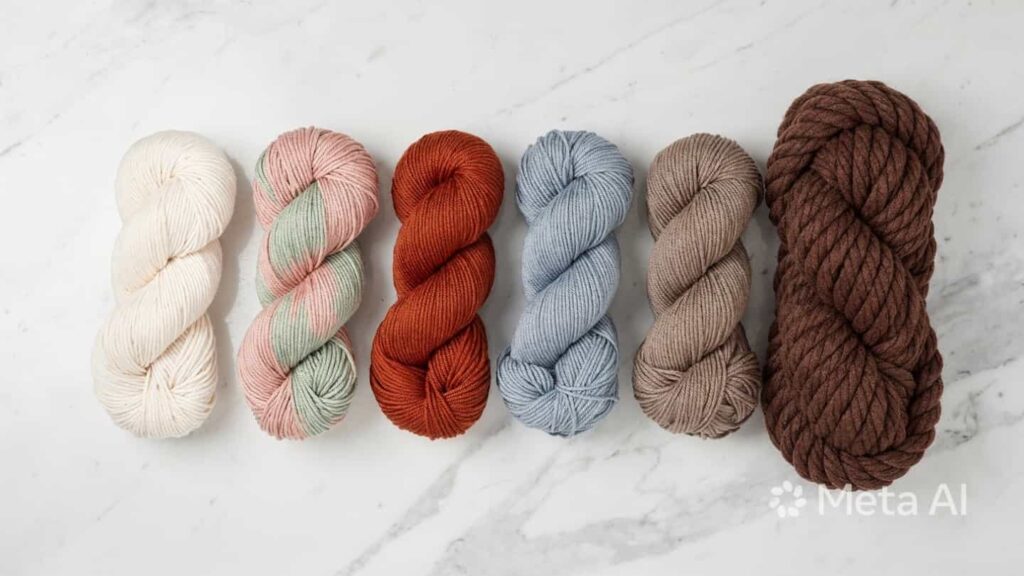
Yarn weight is the thickness of your yarn, rated on a standardized scale:
| Weight Label | CYCA # | Typical Gauge (per 4″) | Yardage per lb (approx.) |
|---|---|---|---|
| Lace | 0 | 32–42 sts | 2,000–2,500 yds |
| Fingering/Sock | 1 | 28–32 sts | 1,600–2,000 yds |
| Sport | 2 | 24–26 sts | 1,200–1,600 yds |
| DK | 3 | 22–24 sts | 1,000–1,200 yds |
| Worsted | 4 | 16–20 sts | 800–1,000 yds |
| Bulky | 5 | 12–15 sts | 500–700 yds |
| Super Bulky | 6 | 7–11 sts | 300–500 yds |
| Jumbo | 7 | 6 or fewer sts | Under 300 yds |
3. Your Gauge
Gauge is the number of stitches and rows per inch that you produce with a specific yarn and needle/hook size. This is personal — two people using identical yarn and hooks can produce wildly different gauges.
Always swatch before calculating. Skipping your gauge swatch is the #1 cause of inaccurate yardage estimates and ill-fitting finished objects.
4. Stitch Pattern
Not all stitches are created equal when it comes to yarn consumption:
- Single crochet uses more yarn than double crochet
- Cables and brioche use 10–30% more yarn than stockinette
- Colorwork (stranding, intarsia) adds significant yardage
- Lace patterns can use less yarn due to open structure
If your pattern uses a combination of stitches, estimate conservatively and always add a buffer.
Click here to Use Stitch Counter Tool
Yardage Quick-Reference Guide by Project Type
This reference chart gives you a ballpark before you even open a calculator. Treat these as starting points — your actual needs will vary based on gauge, yarn weight, and size.
Blankets & Afghans
| Project | Yardage Range (Worsted Weight) |
|---|---|
| Baby blanket (30″ × 36″) | 800 – 1,200 yards |
| Lap blanket (36″ × 48″) | 1,200 – 1,800 yards |
| Throw (50″ × 60″) | 1,500 – 2,500 yards |
| Queen afghan (60″ × 80″) | 3,000 – 4,500 yards |
| King afghan (76″ × 80″) | 4,000 – 6,000 yards |
Garments
| Project | Yardage Range |
|---|---|
| Baby cardigan | 400 – 800 yards |
| Child’s sweater | 600 – 1,200 yards |
| Women’s pullover (M) | 1,000 – 1,500 yards |
| Men’s sweater (L) | 1,400 – 2,000 yards |
| Long cardigan | 1,800 – 2,500 yards |
Accessories
| Project | Yardage Range |
|---|---|
| Beanie/Hat (adult) | 100 – 200 yards |
| Scarf (standard) | 300 – 500 yards |
| Socks (pair) | 350 – 450 yards |
| Shawl/Wrap | 400 – 1,200 yards |
| Mittens (pair) | 150 – 250 yards |
Note: Crochet projects typically use approximately 30% more yarn than a knit version of the same project at the same gauge, because each stitch wraps more yarn.
How to Use a Yarn Yardage Calculator: Step-by-Step
Here’s the exact process to get a reliable yardage estimate — whether you’re using an online tool or doing the math yourself.
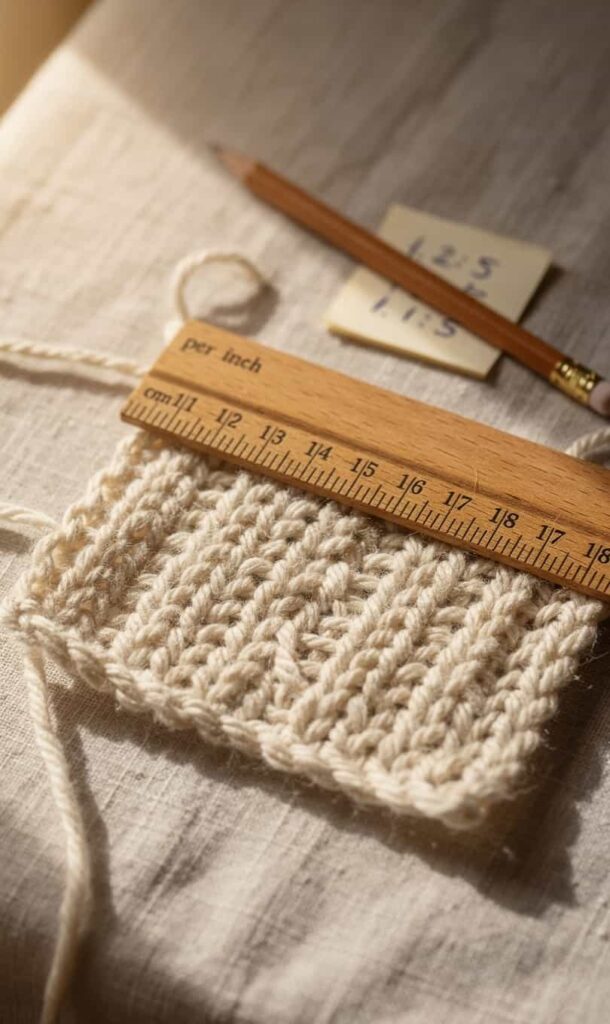
Step 1: Swatch Your Gauge
Knit or crochet a 6″ × 6″ square using the yarn and hook/needle size you plan to use. Measure the stitches and rows within a 4″ section in the center. This is your personal gauge.
Step 2: Choose Your Calculator Mode
Most online yardage calculators offer two modes:
- Project-based: Select your project type, size, and yarn weight. The tool provides an instant estimate using industry-average data.
- Gauge-based: Enter your exact stitch and row count per inch, plus your project dimensions, for a more personalized result.
Use the gauge-based mode whenever precision matters — garments, especially.
Step 3: Enter Your Project Dimensions
Input length and width in your preferred units (inches, centimeters, or meters). For garments, select the size or enter your finished measurements.
Step 4: Select Yarn Weight
Choose your yarn weight from the dropdown. If your yarn is between categories, select the heavier option and use the buffer in Step 6 to compensate.
Step 5: Add Your Stitch Pattern Multiplier
If your pattern involves cables, colorwork, or dense stitches, mentally add 10–20% to the calculator’s base estimate. Some advanced calculators include a stitch pattern selector.
Step 6: Apply the 10–15% Buffer Rule
Add your chosen 10–15% allowance to the base estimate. If you use GaugeGenie’s “With 10% Extra” total, that 10% allowance is already included. An allowance can cover:
- Gauge swatching (which uses 20–40 yards)
- Frogging and re-knitting mistakes
- Edging, seams, and finishing
- Dye lot insurance
If you’re making modifications or your gauge swatch wasn’t perfect, round up to the next full skein.
Step 7: Convert to Skeins
Divide your total yardage (with buffer) by the yardage listed on your chosen yarn’s label. Round up — never down.
Example:
- Calculated yardage: 1,320 yards
- 15% buffer: +198 yards → Total: 1,518 yards
- Skein yardage (label): 220 yards per skein
- Skeins needed: 1,518 ÷ 220 = 6.9 → buy 7 skeins
How to Calculate Yardage by Weight (No Label Needed)
Lost your yarn label? Have a mystery skein from your stash? You can still calculate usable yardage using a kitchen scale.
The Weight-to-Yardage Method
What you need: A digital scale (accurate to 0.1g), the full skein or partial skein.
Step 1: If you have the label for a similar skein of the same yarn, note its total length (yards) and total weight (grams).
Step 2: Calculate the yards-per-gram ratio:
Total yards ÷ Total grams = Yards per gram
Example: 220 yards ÷ 100g = 2.2 yards per gram
A worsted weight yarn typically falls between 1.7 – 2.3 yards per gram.
Step 3: Weigh your mystery skein in grams.
Step 4: Multiply weight × yards-per-gram ratio.
73g × 2.2 = 160.6 yards remaining
No similar label available? Cut exactly 1 yard of the yarn and weigh it. Divide 1 by that weight in grams to get your yards-per-gram ratio. Weigh the rest of the skein and apply the formula.
This method works equally well for finished projects — if you want to know how much yarn is in a completed hat, weigh it (subtract any non-yarn additions like buttons or wire), then apply the formula.
Yarn Substitution Math: Swapping Yarns the Smart Way
The pattern calls for Brand A, but you want to use Brand B. Here’s how to make sure the math works.
The Substitution Formula
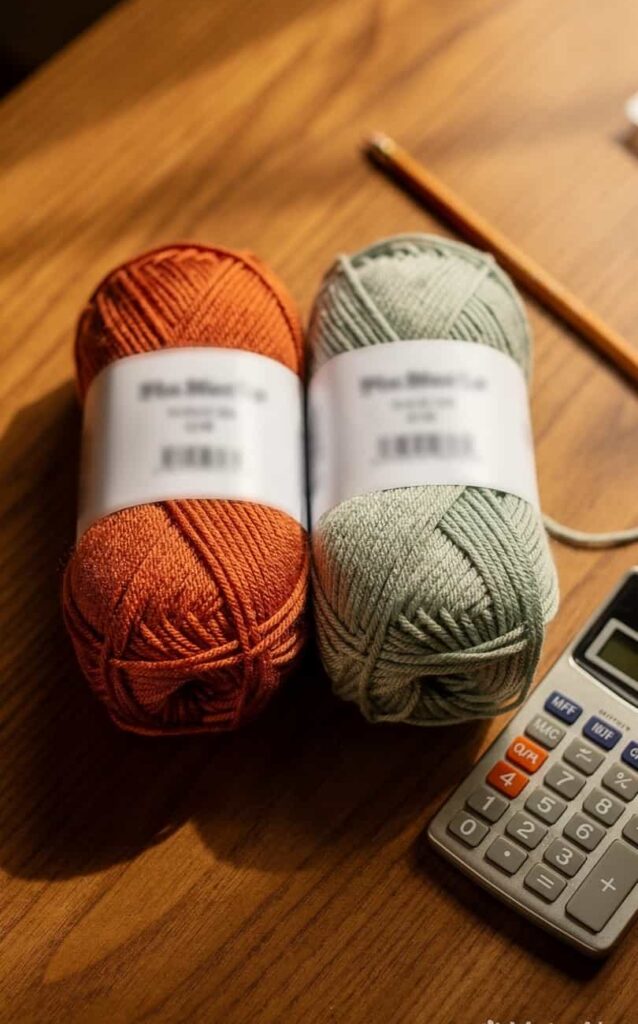
- Find the total yardage the pattern requires (pattern’s skeins × yards per skein for the original yarn).
- Divide that total by the yardage per skein of your substitute yarn.
- Round up to the nearest whole skein.
- Add your 10–15% buffer.
Example:
- Pattern calls for: 6 skeins × 190 yards = 1,140 yards total
- Substitute yarn: 210 yards per skein
- Skeins needed: 1,140 ÷ 210 = 5.4 → buy 6 skeins
- With 15% buffer: 1,311 yards ÷ 210 = 6.2 → buy 7 skeins
Critical: Match by yardage, not by weight. Two skeins of “worsted weight” yarn from different brands can have wildly different yardage. A 50g skein of lace can contain 400+ yards; a 200g bulky skein might hold only 150 yards.
Check Fiber Content Too
Fiber behavior affects yardage consumption. Wool stretches and has memory; cotton does not. Fibers with more drape, like silk or bamboo, may knit up slightly differently than the same weight in wool. If in doubt, swatch — always.
5 Common Mistakes Crafters Make (And How to Fix Them)
❌ Mistake 1: Shopping by Weight Instead of Yardage
Two skeins can weigh the same but contain completely different amounts of yarn. Always check the yardage on the label, not just the weight in grams or ounces.
❌ Mistake 2: Skipping the Gauge Swatch
Your gauge directly determines your yardage. If you knit tighter than the designer, you’ll use more yarn. If you knit looser, you’ll use less — and your project might not fit. Swatching is a yardage forecast, not a formality.
❌ Mistake 3: Buying Yarn from Different Dye Lots
Yarn is dyed in batches called dye lots. Even the same colorway can differ visibly between lots. Always buy all your skeins at once — from the same dye lot number — especially for large projects like sweaters and blankets.
❌ Mistake 4: Forgetting to Account for Stitch Pattern
Cables, colorwork, bobbles, and dense textured stitches consume significantly more yarn than plain stockinette or single crochet. If your pattern is stitch-heavy, add 15–25% to your baseline estimate.
❌ Mistake 5: Not Keeping a Project Record
The single most valuable habit for any crafter: write down how much yarn you actually used. Over time, this personal yardage log becomes more accurate than any calculator because it’s calibrated to your gauge and knitting style.
Expert Tips to Get More Accurate Estimates Every Time
- Weigh your gauge swatch. After knitting a swatch, weigh it, then apply the weight-to-yardage formula to understand exactly how much yarn that size of fabric requires per gram.
- Use project-tracking apps. Tools like Ravelry let you log yarn used per project, building a personal yardage database over time.
- Know your loom waste (for weavers). Most looms waste between 20″–30″ of warp yarn that can’t be woven. Always factor this into weaving calculations.
- Buy an extra skein as insurance. If you finish the project without using it, most yarn shops with good return policies will take it back. Peace of mind is worth the purchase.
- For hand-dyed yarns, add more buffer. Hand-dyed yarn — even in the same “colorway” — can shift between batches. Buy generously.
Real-World Scenario: Calculating Yarn for a Custom Sweater
Let’s walk through an end-to-end example.
The Project: A women’s pullover, size medium, knit in worsted weight yarn. Chosen Yarn: 200-yard skeins at $14 each. Gauge Swatch Result: 18 stitches × 24 rows per 4 inches (matches the pattern gauge). Stitch Pattern: Mostly stockinette with a cable panel on the front.
Step 1: Base yardage estimate from a gauge-based calculator → 1,250 yards
Step 2: Cable panel adjustment (+15%) → 1,250 × 1.15 = 1,437 yards
Step 3: Add 10% buffer for dye lot safety, swatching, and seams → 1,437 × 1.10 = 1,581 yards
Step 4: Divide by skein yardage → 1,581 ÷ 200 = 7.9 → buy 8 skeins
Total cost: 8 × $14 = $112 — all budgeted and planned before purchasing a single skein.
Metric vs. Imperial: A Quick Conversion Reference
Many European yarns are labeled in meters, while most North American patterns are written in yards.
| Conversion | Formula |
|---|---|
| Yards → Meters | Multiply yards × 0.9144 |
| Meters → Yards | Multiply meters × 1.0936 |
| Ounces → Grams | Multiply oz × 28.35 |
| Grams → Ounces | Multiply g × 0.0353 |
Most online yarn calculators support both metric and imperial inputs — just make sure you’re consistent throughout your calculation.
The Bottom Line: Your Yarn Math Made Simple
Running out of yarn isn’t a personality flaw — it’s a planning gap. A yarn yardage calculator, used correctly, closes that gap in minutes.
Here’s the workflow that never fails:
- Swatch your gauge before anything else
- Enter accurate project dimensions into a calculator
- Adjust for stitch pattern complexity
- Add 10–15% to the result
- Buy all skeins from the same dye lot
- Record what you actually used for next time
The math isn’t complicated — it just needs to happen before you fall in love with a yarn and impulse-buy three skeins that turn out to be two short.
Ready to start calculating? Try one of the excellent free tools at sites like B.Hooked Crochet, Joy of Motion Crochet, or Darn Good Yarn — all linked above. Then come back and tell us in the comments: what project finally convinced you to take yarn math seriously?
Frequently Asked Questions
How does a yarn yardage calculator work?
A yarn yardage calculator estimates the total length of yarn needed for a project by combining your project size, yarn weight category, and gauge information. It uses industry-standard yarn consumption benchmarks and adjusts the output based on your inputs. The result is an estimated yardage figure you can use to determine how many skeins to purchase. Most calculators recommend adding a 10–15% buffer to the result for safety.
How much yarn do I need for a blanket?
The amount of yarn needed for a blanket depends on its size and the yarn weight you’re using. As a general guide: a baby blanket (30″×36″) requires 800–1,200 yards of worsted weight yarn; a standard throw (50″×60″) needs 1,500–2,500 yards; and a large queen-size afghan (60″×80″) can require 3,000–4,500 yards. Crochet projects typically use about 30% more yarn than the equivalent knit project.
Can I use a yarn yardage calculator for yarn substitution?
Yes — and this is one of the most practical uses of a yarn calculator. To substitute yarn, calculate the total yardage required by the pattern (pattern skeins × yards per skein of the original yarn), then divide by the yardage per skein of your substitute. Always match substitute yarn by yardage rather than weight, and add a 10–15% buffer to your total. Swatching with the substitute yarn is essential since gauge affects yardage consumption.
What is the 10–15% buffer rule in yarn calculations?
A 10–15% allowance adds extra yarn to your base estimate for swatching, finishing, mistakes and changes to the project. GaugeGenie displays a separate “With 10% Extra” total that already includes a 10% allowance. Choose the total you plan to use, then divide by the yardage per skein on your chosen yarn label and round up to whole skeins. Check your pattern, swatch and yarn before buying.
How do I calculate yarn yardage without a label?
If you’ve lost a yarn label, you can calculate yardage by weight using a digital kitchen scale. Weigh 1 yard of the yarn in grams, then divide 1 by that weight to get the yards-per-gram ratio. Weigh your full skein and multiply by the ratio. Alternatively, if you have another skein of the same yarn with its label intact, divide the labeled yardage by the labeled gram weight to find the yards-per-gram ratio, then apply it to the weight of your unlabeled skein. For worsted weight yarn, the ratio typically falls between 1.7 and 2.3 yards per gram.
Found this guide helpful? Share it with your knitting circle or pin it for your next project planning session. Got a yarn math question we didn’t cover? Drop it in the comments — we read every one.
Join Our Crafting Community
Follow GaugeGenie for daily yarn inspiration, pattern tips, and free calculator updates — wherever you craft.

[…] medium weight yarn, suited for most everyday projects, and you will get 200 yards per skein. Use a Yarn Yardage Calculator to figure out how many skeins you […]