
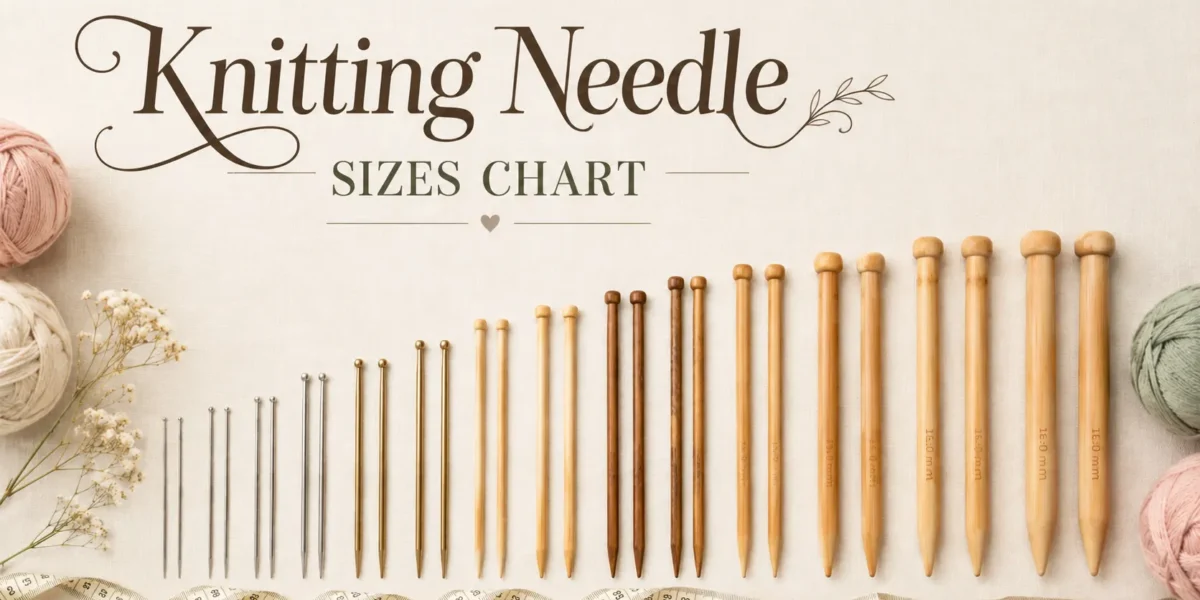
What is a knitting needle sizes chart? A knitting needle sizes chart is a reference table that cross-lists the three main needle sizing systems, US numbers, old UK numbers, and metric diameters (mm) so knitters can quickly find the correct equivalent when a pattern uses a different system than their needles.
Introduction
If you’ve ever stared at a knitting pattern that calls for a “size 8” needle while your needle case only shows millimetres, you already know why a reliable knitting needle sizes chart is one of the most-used tools in a knitter’s arsenal.
The confusion is real and it’s not your fault. Knitting needles are sized using three completely different systems depending on where the pattern was written, how old it is, and which country published it. A US size 8, a UK size 0, and a 5 mm needle can all refer to the exact same needle. Until you know the conversion, you’re essentially trying to read three different languages simultaneously.
This guide cuts through every bit of that confusion. Whether you’re a beginner choosing your first set of straights or an experienced knitter decoding a vintage British pattern from the 1970s, you’ll find everything you need here including the complete knitting needle sizes chart, yarn-weight pairings, gauge advice, material comparisons, and expert tips built on decades of collective knitting knowledge.
Let’s start with the chart itself.
Quick Knitting Needle Sizes Chart (2026 Reference)
Here’s the fast-reference version for when you need an answer quickly. The full conversion chart with additional detail follows in the next section.
| Metric (mm) | US Size | Old UK Size | Common Yarn Weight |
|---|---|---|---|
| 2.0 mm | 0 | 14 | Lace / Cobweb |
| 2.25 mm | 1 | 13 | Lace / Fingering |
| 2.75 mm | 2 | 12 | Fingering / Sock |
| 3.25 mm | 3 | 10 | Fingering / Sport |
| 3.5 mm | 4 | — | Sport / DK |
| 3.75 mm | 5 | 9 | DK |
| 4.0 mm | 6 | 8 | DK / Worsted |
| 4.5 mm | 7 | 7 | Worsted |
| 5.0 mm | 8 | 6 | Worsted / Aran |
| 5.5 mm | 9 | 5 | Aran |
| 6.0 mm | 10 | 4 | Bulky |
| 6.5 mm | 10.5 | 3 | Bulky |
| 8.0 mm | 11 | 0 | Super Bulky |
| 9.0 mm | 13 | 00 | Super Bulky |
| 10.0 mm | 15 | 000 | Jumbo |
| 12.0 mm | 17 | — | Jumbo |
| 15.0 mm | 19 | — | Jumbo |
| 25.0 mm | 50 | — | Extreme / Arm Knitting |
Pro tip: When in doubt, always go by millimetre (mm) measurements. The metric system is the international standard and is stamped on all modern needles. US and UK numbers are secondary references only.
US vs UK vs Metric: Why Are There Three Different Needle Sizing Systems?
This is the question every knitter eventually asks and it has a genuinely interesting answer.
The US Sizing System
The US numbering system runs roughly from 0 (very fine, ~2 mm) to 50 (enormous, ~25 mm). The numbers increase as the needles get larger which feels logical until you realise the relationship between number and actual diameter is not perfectly linear. A US size 10 is not exactly twice the diameter of a US size 5. The US system was developed by American needle manufacturers in the early 20th century and varied slightly between brands for decades. It became more standardised over time but inconsistencies still exist in vintage patterns and older needle sets.
The Old UK / British Sizing System
The old UK (Imperial) sizing system runs in the opposite direction. UK size 14 is the smallest (about 2 mm), and the numbers decrease as needles get larger. A UK size 8 is around 4 mm, while a UK size 0 is about 8 mm and it goes into double zeros (00, 000) for the very largest needles.
This reverse numbering is the source of enormous confusion, especially when knitters encounter vintage British knitting patterns from the 1950s–1980s. A pattern calling for “size 8 needles” written in the UK means something completely different from the same instruction in an American pattern.
The UK officially switched to metric needle sizing in the 1970s, so any modern British pattern should use millimetres. But millions of vintage patterns still circulate with the old system, and many heirloom knitters still refer to needles by their old UK numbers out of habit.
The Metric System (mm)
The metric system is the current international standard, adopted by the Craft Yarn Council (CYC), which is the leading industry body that sets yarn and needle standards in North America, and widely used by knitting organisations worldwide including the UK Hand Knitting Association.
Every modern needle regardless of where it was manufactured is now sized by its diameter in millimetres. This is the most reliable system because:
- It directly measures the physical tool
- It’s universal across all countries
- It’s stamped or laser-engraved on the needle shaft
- It removes ambiguity entirely
Bottom line: If your needle says “5.0 mm,” that is definitively a 5 mm needle. Whether it’s also called a US 8 or not is secondary information.
Full Needle Size Conversion Chart
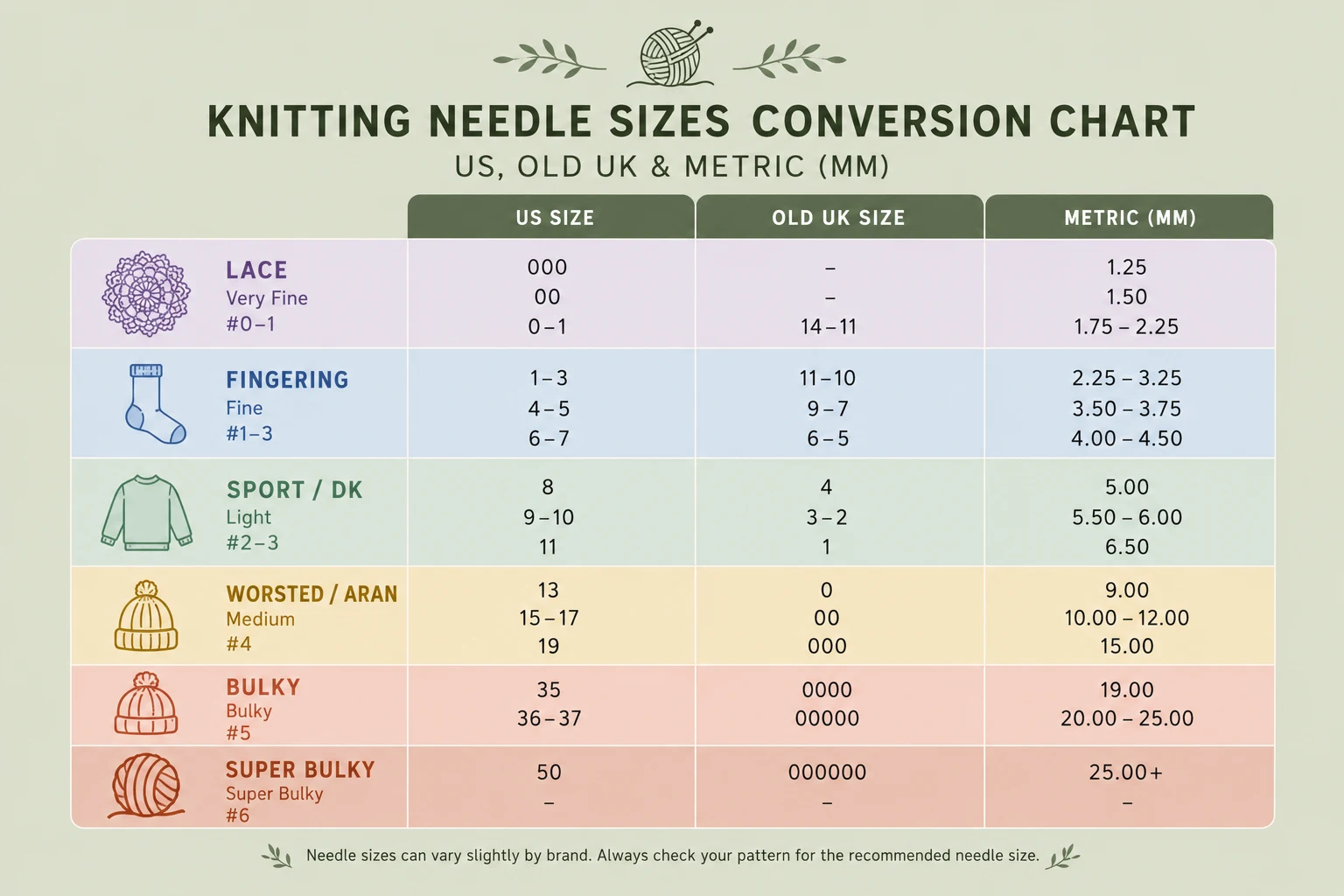
This is the complete knitting needle sizes chart, covering every standard size across all three systems. Where there is no direct equivalent, a dash (—) is used.
| Metric (mm) | US Size | Old UK Size | Notes |
|---|---|---|---|
| 2.0 mm | 0 | 14 | Lace knitting; very fine steel needles |
| 2.25 mm | 1 | 13 | Fingering weight socks |
| 2.5 mm | 1.5 | — | Less common; some European patterns |
| 2.75 mm | 2 | 12 | Standard sock needle size |
| 3.0 mm | 2.5 | 11 | Fine sock/fingering |
| 3.25 mm | 3 | 10 | Fingering; baby knits |
| 3.5 mm | 4 | — | Light DK; no old UK equivalent |
| 3.75 mm | 5 | 9 | DK weight standard |
| 4.0 mm | 6 | 8 | DK; most common beginner size |
| 4.25 mm | 6 (alt) | — | Rare; some brands only |
| 4.5 mm | 7 | 7 | Worsted weight |
| 5.0 mm | 8 | 6 | Worsted standard; scarves & hats |
| 5.5 mm | 9 | 5 | Aran weight; cosy knits |
| 6.0 mm | 10 | 4 | Bulky weight |
| 6.5 mm | 10.5 | 3 | Bulky; fast projects |
| 7.0 mm | 10.75 | 2 | Bulky/super bulky transition |
| 8.0 mm | 11 | 0 | Super bulky blankets |
| 9.0 mm | 13 | 00 | Super bulky cowls |
| 10.0 mm | 15 | 000 | Jumbo weight |
| 12.0 mm | 17 | — | Chunky arm-knit adjacent |
| 15.0 mm | 19 | — | Extreme knitting |
| 19.0 mm | 35 | — | Arm/hand knitting |
| 25.0 mm | 50 | — | Extreme/arm knitting only |
A Note on the “Gap” Sizes
You’ll notice some metric sizes (like 3.5 mm, 4.25 mm, 7.0 mm) have no clean US equivalent or a fractional one. This is because the US system was not designed with even metric progression in mind. Different manufacturers filled these gaps over time with their own numbering conventions, which is why you may see a 3.5 mm labelled “US 4” by one brand and “US E” (it’s not that’s crochet) by another.
Always trust the mm measurement over the US number if there’s any doubt.
Needle Sizes by Yarn Weight
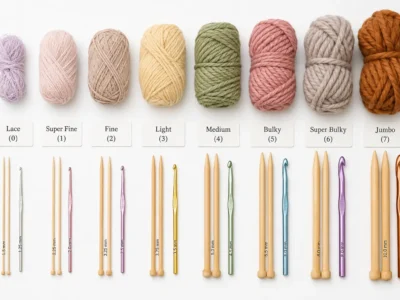
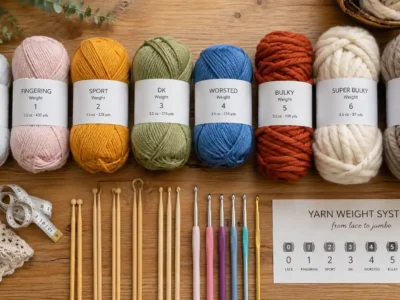
Understanding how needle size pairs with yarn weight is foundational to getting the right fabric. The Craft Yarn Council’s standardised yarn weight system (0 through 7) gives a consistent starting framework.
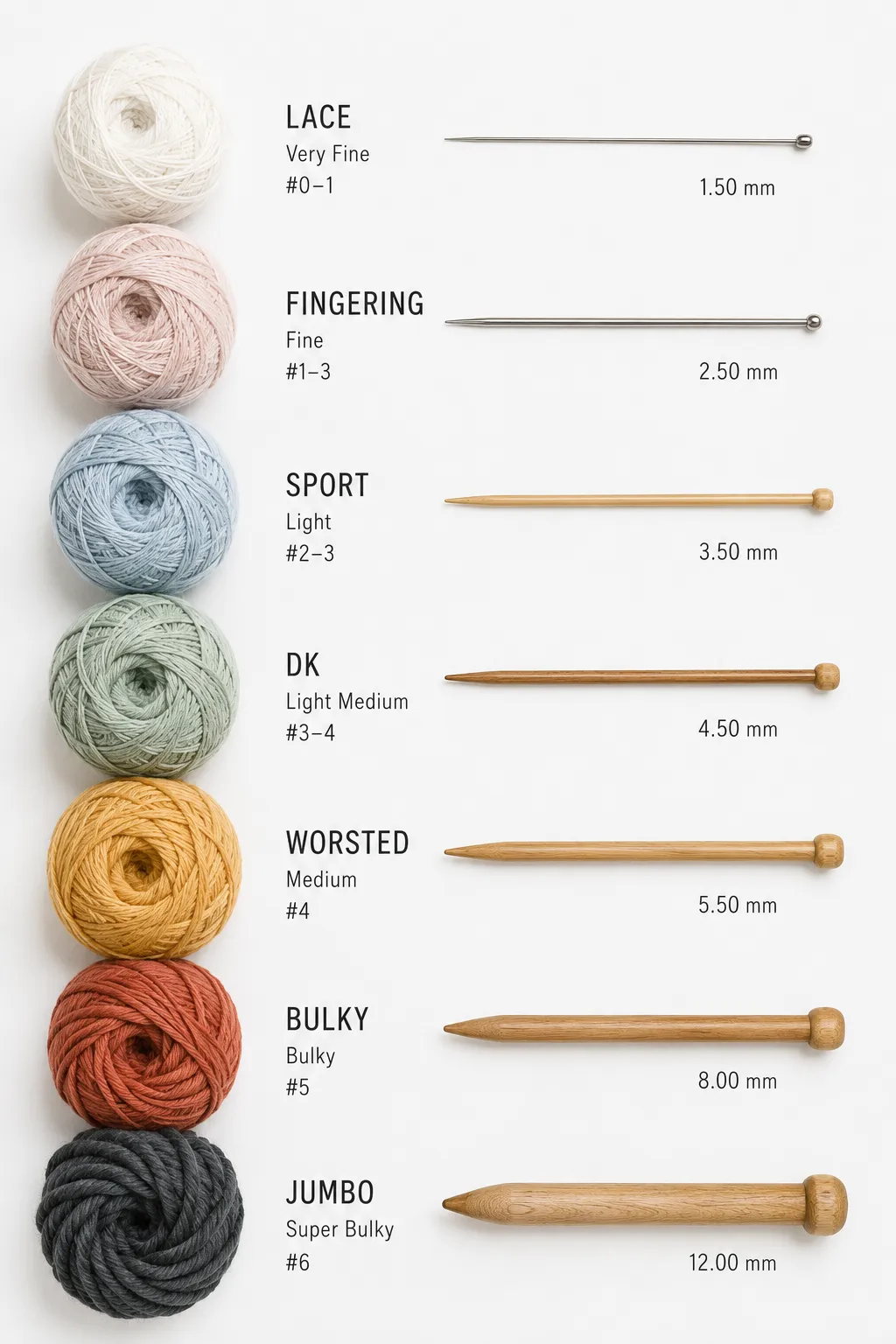
| CYC Yarn Weight | Weight Name | Recommended Needle (mm) | US Size | Typical Uses |
|---|---|---|---|---|
| 0 | Lace | 1.5 – 2.25 mm | 000 – 1 | Shawls, doilies, lace scarves |
| 1 | Fingering / Sock | 2.25 – 3.25 mm | 1 – 3 | Socks, baby items, fine shawls |
| 2 | Sport | 3.25 – 3.75 mm | 3 – 5 | Baby clothes, lightweight sweaters |
| 3 | DK (Double Knit) | 3.75 – 4.5 mm | 5 – 7 | Hats, mitts, light sweaters |
| 4 | Worsted | 4.5 – 5.5 mm | 7 – 9 | Scarves, hats, sweaters, afghans |
| 5 | Bulky | 6.0 – 8.0 mm | 10 – 11 | Cowls, blankets, quick gifts |
| 6 | Super Bulky | 9.0 – 16.0 mm | 13 – 19 | Chunky blankets, quick scarves |
| 7 | Jumbo | 19 mm+ | 35+ | Arm knitting, extreme projects |
Important Caveat
These are starting recommendations, not rules. Your individual tension (gauge) will determine whether you need to go up or down a needle size. A tight knitter might use a 5.5 mm needle with DK yarn to match a pattern’s gauge. A loose knitter might use 3.75 mm for the same yarn. We cover this in detail in the gauge section below.
For a deeper dive into yarn classifications, see our complete Yarn Weight Chart which covers fibre content, metreage, and project suitability.
Best Needle Sizes for Specific Projects
Socks
Best needle size: 2.0 – 2.5 mm (US 0 – 1.5)
Sock knitting almost always uses fingering or sock weight yarn at a tight gauge. The small needle size creates a dense, durable fabric that holds up to the wear and washing socks endure. Most sock patterns specify 2.0 mm, 2.25 mm, or 2.5 mm needles.
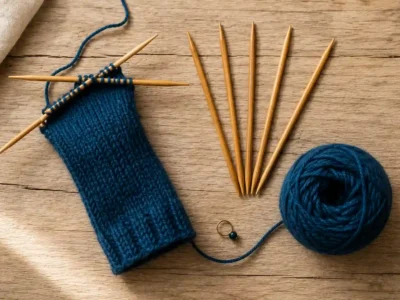
- Most knitters use sets of 4 or 5 double-pointed needles (DPNs) or a magic loop technique on a long circular needle (80–100 cm / 32–40 in)
- A tighter gauge (more stitches per 10 cm) = more durable fabric
- Sample gauge: 32–36 stitches per 10 cm on 2.25 mm needles
Scarves
Best needle size: 4.5 – 6.0 mm (US 7 – 10)
Scarves are incredibly forgiving projects. Most beginner patterns use worsted weight yarn on 5.0–5.5 mm needles because the stitch definition is clear, the fabric knits up quickly, and gauge is not critical (scarves don’t need to fit anyone precisely).
- For a drapey, lacy scarf, go up one or two needle sizes from the yarn label recommendation
- For a dense, warm scarf, go down one size
- Sample gauge: 18–20 stitches per 10 cm on 5.0 mm needles with worsted weight
Sweaters
Best needle size: 3.5 – 5.5 mm (US 4 – 9), depending on yarn weight
Sweaters demand accurate gauge swatching because even a small deviation per stitch multiplies across hundreds of stitches. A sweater knit 10% looser than specified can be 5 cm too wide.
| Sweater Yarn Weight | Needle Range | Gauge Target |
|---|---|---|
| DK | 3.75 – 4.5 mm | 22–24 sts / 10 cm |
| Worsted | 4.5 – 5.5 mm | 18–20 sts / 10 cm |
| Aran | 5.0 – 5.5 mm | 16–18 sts / 10 cm |
| Bulky | 6.0 – 8.0 mm | 12–14 sts / 10 cm |
Free Tool
Gauge Calculator
Use our Gauge Calculator to instantly convert your personal swatch measurements into the right needle size adjustment.
Calculate My GaugeBlankets
Best needle size: 6.0 – 12.0 mm (US 10 – 17)
Blankets reward bulky and super bulky yarn paired with large needles. The chunky fabric knits up fast and the loose tension creates a cosy drape. Many popular patterns use 9.0 mm–10.0 mm needles.
- Circular needles are essential for blankets you simply can’t fit the stitch count on straights
- A 100 cm (40 in) circular is the most versatile length for throw-sized blankets. Track your yarn consumption with our Yarn Yardage Calculator before casting on
Circular vs Straight Needle Sizing: Is There a Difference?
No, the tip diameter is identical. A 5.0 mm straight needle and a 5.0 mm circular needle have the same diameter at the working tip. The size refers purely to the thickness of the needle, not its shape or configuration.
That said, there are practical differences worth knowing:
| Feature | Straight Needles | Circular Needles |
|---|---|---|
| Sizing | Same mm as circular | Same mm as straight |
| Length (typical) | 25 cm, 30 cm, 35 cm | 40 cm, 60 cm, 80 cm, 100 cm, 120 cm |
| Best for | Small flat pieces | Large projects, seamless knitting |
| Weight distribution | Heavier in hands | Lighter — weight on lap |
| Travel-friendly | Less so (long pointy ends) | Yes (no sticking out) |
| Stitch capacity | Limited by length | Virtually unlimited |
Double-pointed needles (DPNs) use the same mm sizing as straights and circulars and are used primarily for small circumference knitting socks, sleeves, hat crowns, and mittens.
Interchangeable Needle Sets
Modern interchangeable circular needle systems (from brands like Addi, Lykke, Knitter’s Pride, and ChiaoGoo) use tips and cables that detach. The tips are sized in mm, exactly like fixed circulars. These systems are a smart investment because one set covers every size and cord length combination.
How Needle Size Affects Gauge (And Why It Matters)
Gauge (called tension in UK/Australian patterns) is the number of stitches and rows per 10 cm (or 4 inches) of knitted fabric.
Definition: Gauge is the measurement of how many stitches fit into a given width of fabric. It is determined by three factors: yarn weight, needle size, and individual knitting tension.
The Core Relationship
- Larger needles → bigger stitches → fewer stitches per 10 cm → loose, drapey fabric
- Smaller needles → smaller stitches → more stitches per 10 cm → dense, firm fabric
This is why the yarn label’s recommended needle size is a starting point, not a guarantee. Two knitters using identical yarn and needles can produce swatches with noticeably different gauges because their individual tension differs.
How to Measure Your Gauge
- Cast on at least 30 stitches with your chosen needle size
- Knit at least 10 cm (4 inches) in stockinette (or the pattern stitch)
- Bind off or leave on needle and block the swatch
- Once dry, use a ruler or gauge tool to count stitches across a 10 cm span in the centre of the swatch
- Compare your count to the pattern’s specified gauge
If you have too many stitches per 10 cm: Your tension is too tight go up one needle size. If you have too few stitches per 10 cm: Your tension is too loose go down one needle size.
Why Gauge Matters More for Some Projects
| Project Type | Gauge Criticality | Why |
|---|---|---|
| Fitted sweaters | Critical | Size must match the body |
| Socks | Important | Foot size must be accurate |
| Scarves | Low | No fit required |
| Blankets | Low–Medium | Size variation is acceptable |
| Washcloths | Low | Flexible sizing |
| Stuffed toys/amigurumi | Important | Stuffing shows through loose gauge |
🧶 Free Tool
Gauge Calculator
Use our Gauge Calculator to instantly convert your personal swatch measurements into the right needle size adjustment.
Calculate My Gauge →Common Beginner Mistakes with Needle Sizes
Even experienced knitters make these errors. Knowing them upfront saves hours of frustration.
Mistake 1: Ignoring the Gauge Swatch
This is the single most common beginner error. Skipping the swatch and casting straight onto a project especially a sweater almost always leads to a finished item that doesn’t fit. Always swatch. Always.
Mistake 2: Trusting the US Number Over the mm Measurement
US numbers are not perfectly standardised across manufacturers or time periods. A vintage set of needles labelled “US 8” might actually be 4.8 mm or 5.1 mm, not exactly 5.0 mm. If your gauge is off, measure the actual needle diameter with a needle gauge tool (a small card or disc with holes) and use the mm reading.
Mistake 3: Misreading Old UK Patterns
As explained earlier, the old British system runs in reverse. If you pick up a vintage UK pattern and use the number as if it were a US size, you’ll knit with needles that are wildly the wrong size.
Rule of thumb: Any British pattern published before 1980 almost certainly uses old UK sizing. Use a conversion chart (like the one above) to find the metric equivalent.
Mistake 4: Using the Wrong Needle for Circular Projects
Many beginners try to knit hats or socks on straight needles because that’s what they learned on. This can work for flat sections but requires awkward seaming. The right tool is:
- DPNs or a short circular (40 cm) for small circumferences
- Magic loop on a long circular (80 cm+) for adjustable circumferences
Mistake 5: Not Accounting for Needle Material
The material of your needle affects your knitting speed, stitch tension, and yarn grip which can effectively change your gauge even without changing the size.
How to Choose the Right Knitting Needle
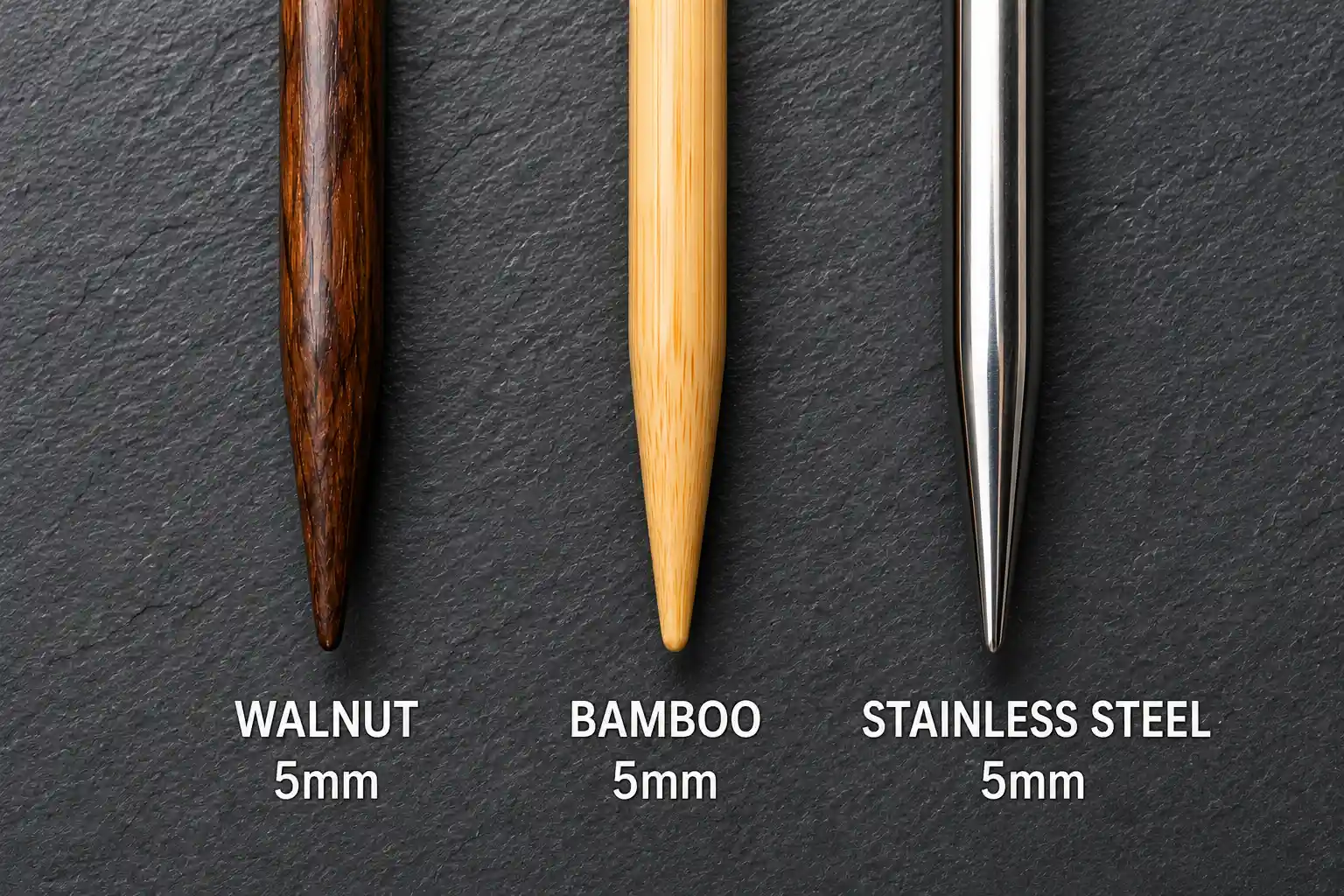
Choosing the right needle involves three decisions: size, material, and type.
Step 1: Match the Size to Your Yarn and Pattern
Use the knitting needle sizes chart above to find the needle the pattern recommends, then swatch to confirm it gives you the correct gauge.
Step 2: Choose the Right Material
| Material | Best For | Pros | Cons |
|---|---|---|---|
| Bamboo | Beginners, slippery yarn | Lightweight, warm, grip | Can snap at small sizes |
| Wood | All knitters | Beautiful, warm feel, slight grip | Pricier, can warp in humidity |
| Stainless Steel / Aluminium | Speed, slick yarn | Fast, smooth, durable | Cold feel; slippery yarn can slide off |
| Plastic / Acrylic | Budget, beginners | Inexpensive, lightweight | Less precise, can bend |
| Carbon Fibre | Advanced, high-end | Incredibly light and smooth | Expensive |
General guidance:
- Bamboo or wood — best for beginners because yarn doesn’t slide off uncontrollably, giving you more control
- Metal needles — best for speed knitters or anyone knitting with sticky fibres like mohair or fuzzy yarn where drag slows you down
- Wooden needles — especially popular with natural fibres like wool and alpaca; the slight texture grips the fibre beautifully
Step 3: Choose the Right Needle Type
- Straight needles — best for flat, small-to-medium projects
- Circular needles — versatile; use for both flat and in-the-round knitting
- Double-pointed needles (DPNs) — best for small tubes (socks, sleeves, hat tops)
- Interchangeable sets — best value for knitters with multiple active projects
Step 4: Consult the Pattern
Many well-written patterns will specify needle type (circular, straights, DPNs) in addition to size. Respect these recommendations they reflect how the designer envisioned the construction.
🪡 Free Tool
Knitting Chart Maker
For building and charting complex stitch patterns, our Knitting Chart Maker is an invaluable planning tool — visualise your design before you cast on.
Open Chart Maker →Frequently Asked Questions About Knitting Needle Sizes
What size knitting needles should a beginner use?
The best beginner knitting needle size is 5.0 mm (US 8) paired with a worsted weight yarn. This combination gives you stitches large enough to see clearly, moves quickly, and is forgiving of tension inconsistencies.
What is the difference between US 8 and UK 8 knitting needles?
They are completely different sizes. A US size 8 needle is 5.0 mm. A UK size 8 needle (old UK system) is 4.0 mm. Always convert to millimetres to eliminate ambiguity.
Are circular knitting needles the same size as straight needles?
Yes. The tip diameter is the same. A 4.0 mm circular needle and a 4.0 mm straight needle are interchangeable in terms of stitch size and gauge.
How do I know what size my unlabelled needles are?
Use a needle gauge tool — a small plate with labelled holes drilled to exact millimetre measurements. Slide the needle into holes until you find the snug fit, then read the mm size.
Why do some patterns give a range of needle sizes?
Patterns recommend a range when gauge is flexible or the pattern is designed for multiple yarn weights. Swatch at the midpoint first, then adjust up or down.
What size knitting needles do I need for chunky blankets?
9.0 mm to 12.0 mm (US 13–17) is the most popular range for chunky throw blankets paired with super bulky or jumbo weight yarn. Always use circular needles for blankets.
Do needle sizes differ between brands?
Modern needles from reputable brands are manufactured to tight tolerances within 0.05–0.1 mm. Cheaper or vintage needles may vary more. For precise gauge work, use consistent, reputable brands.
What does needle size affecting drape mean?
Using a needle larger than recommended creates looser stitches with more airspace, giving fabric a flowing drape. Using a smaller needle creates denser, stiffer fabric. Lace patterns use larger needles deliberately to achieve their open, airy quality.
Final Expert Tips: Making Sense of Every Needle in Your Collection
Here are the insights that separate confident, consistent knitters from frustrated ones:
1. Label your needles immediately. If you buy a needle without a label or inherit a collection, measure them with a gauge tool and mark them with a permanent marker or needle label sticker. Unlabelled needles are a time-wasting mystery.
2. Keep a personal gauge journal. Write down your gauge for each yarn + needle combination you use. Over time, you’ll learn whether you consistently knit loosely or tightly, and you’ll be able to predict your swatch outcome before you even pick up the needles.
3. The label is a suggestion, not a law. The needle size printed on a yarn label is what the manufacturer used to achieve their gauge swatch. Your tension is your own. Trust your swatch.
4. Go metric on everything. When talking to other knitters online, in classes, or through pattern notes, use millimetres. It eliminates every cross-system conversion error instantly and is universally understood.
5. Invest in one good set of interchangeables. A quality interchangeable circular needle set covers every size and cord length combination. Brands like Addi Clicks, ChiaoGoo Red Lace, Lykke Driftwood, and Knitter’s Pride Karbonz are beloved by serious knitters and will last for decades.
6. For vintage British patterns, always convert first. Before casting on any old UK pattern, write the metric equivalents beside every old UK needle number in the pattern. It takes two minutes and prevents an entire project’s worth of confusion.
7. Material matters as much as size. If your gauge is consistently off despite using the right size, try switching needle material. Moving from metal to bamboo can tighten a loose knitter’s gauge; moving from bamboo to metal can loosen a tight one.
Conclusion & Call to Action
The knitting needle sizes chart isn’t just a reference table — it’s the bridge between a pattern written anywhere in the world and the needles sitting in your bag. Once you understand the three systems, their quirks, and how needle size interacts with yarn weight and your personal gauge, you have genuine control over every project you make.
Your next steps:
- 📌 Bookmark this page for instant reference while you knit
- 🧶 Check your yarn’s label against the chart above and verify your needle size
- 📐 Swatch before every fitted project — five minutes now saves hours of frogging later
- 🔗 Dive deeper with our Yarn Weight Chart, Gauge Calculator, and Yarn Yardage Calculator to fully equip yourself for your next cast-on
Happy knitting — and may your gauge always match on the first try.
Join Our Crafting Community
Follow GaugeGenie for daily yarn inspiration, pattern tips, and free calculator updates — wherever you craft.
[…] A bamboo or wood set in one of these sizes gives you a good foundation. Use GaugeGenie’s Knitting Needle Size Chart to match needle size to your yarn […]
[…] check the Needle Size Conversion Chart and Knitting Needle Size Chart when working with metric or international […]