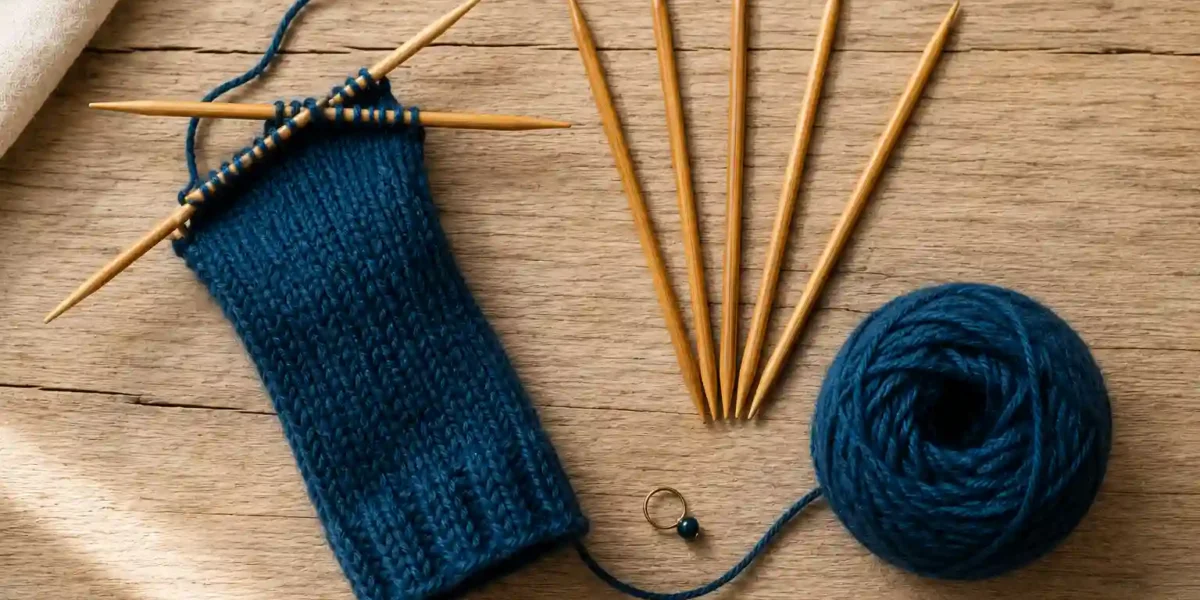
Double Pointed Knitting Needles
If you’ve ever wanted to knit socks, mittens, or a seamless hat crown, you’ve probably come across double pointed knitting needles. These specialized tools are essential for small-circumference knitting in the round and once you learn them, a whole new world of knitting projects opens up.
In this guide, you’ll learn exactly what double pointed knitting needles are, how they work, when to use them, and how to choose the right size and material. Whether you’re a complete beginner or a seasoned knitter looking to sharpen your skills, this guide covers everything.
What Are Double Pointed Knitting Needles?
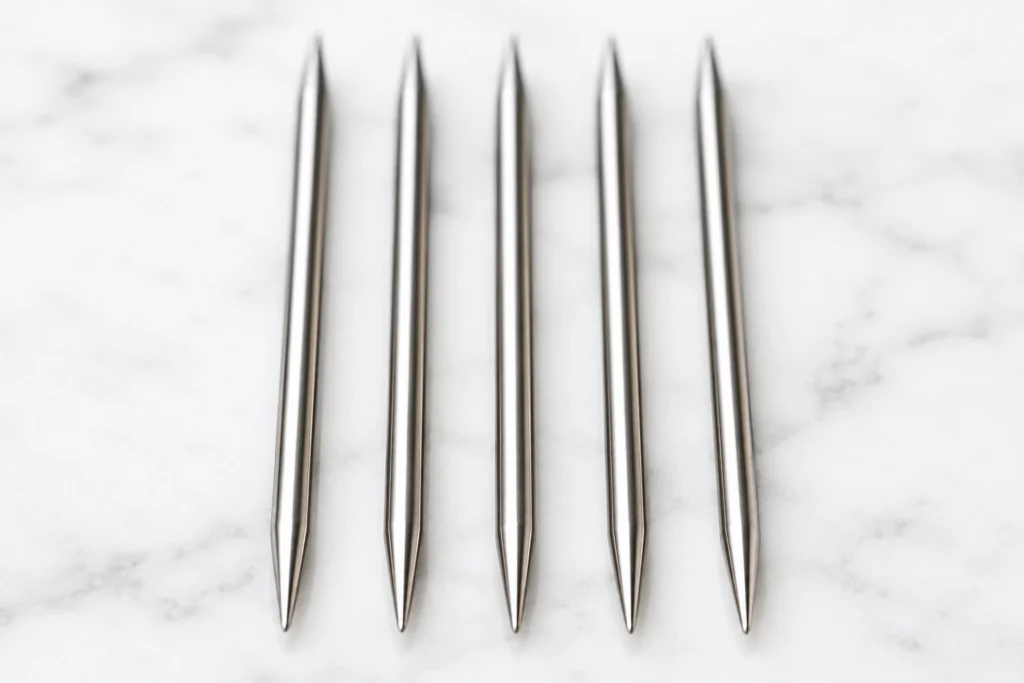
Double pointed knitting needles (DPNs) are short needles with a tapered point at both ends, sold in sets of four or five. Unlike standard single-pointed needles, they have no stopper at the end. This design lets stitches slide freely from one needle to another, making it possible to knit continuously in the round without any seam.
Key Characteristics
- Both ends are pointed — stitches can be worked from either end.
- Short length — typically 5 to 8 inches (13–20 cm).
- Sold in sets of 4 or 5 — you use all needles together as a group.
- No cable required — unlike circular needles, DPNs need no cord.
Why Use Double Pointed Needles?
Double pointed needles solve a very specific problem: knitting in a small circle. Standard circular needles require a minimum circumference to work comfortably. When your project is too small for even the shortest circular needle, DPNs step in.
Benefits of DPNs
- Small circumference knitting — ideal for anything under 12 inches in diameter.
- No minimum stitch count — you can work even just a few stitches per needle.
- Highly portable — small and lightweight, easy to carry anywhere.
- No cable kink — no cord to get in the way.
- Precision shaping — great for tight, controlled decreases at project tips.
- Flexible — usable with any yarn weight when the right size is chosen.
For example, when knitting the thumb of a mitten or the toe of a sock, the stitch count drops too low for circular needles. DPNs handle these transitions effortlessly.
Common Projects Made With DPNs
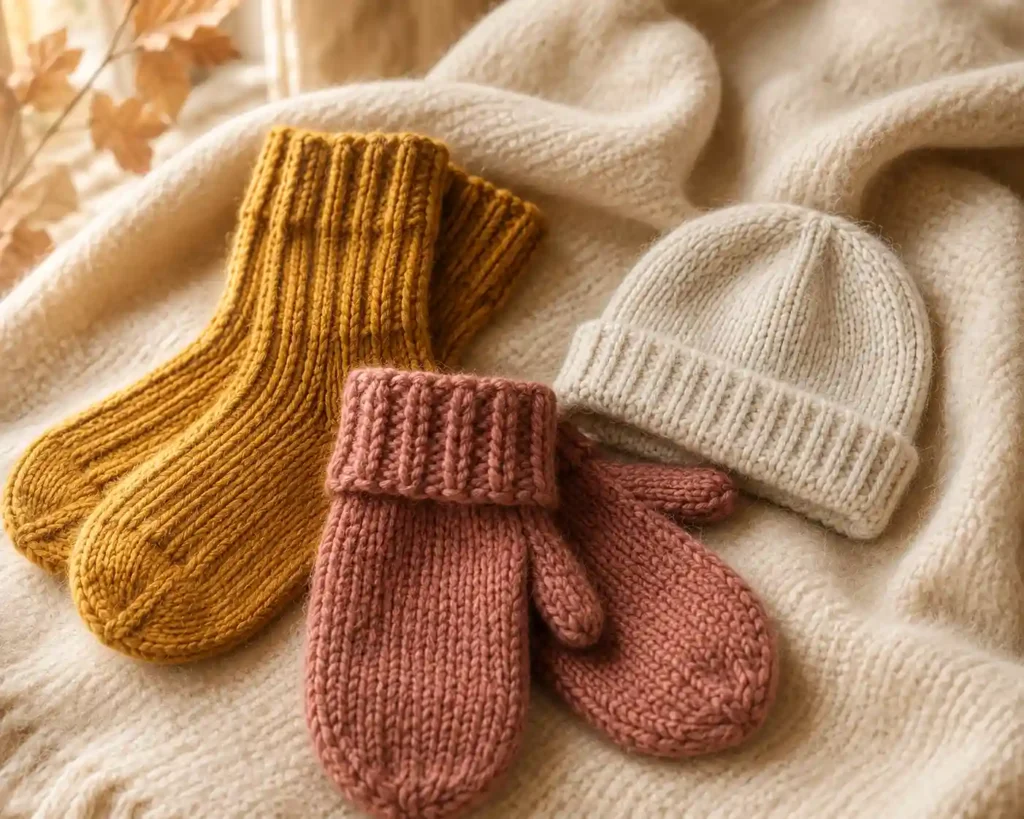
Double pointed knitting excels for any project that is worked in a small tube. Here are the most popular uses:
Socks
Socks are the signature DPN project. The leg, heel, and foot all knit as a tube, while the toe decreases down to just a few stitches. Most sock yarn is fingering weight (US size 1–2 / 2.25–2.75 mm), making DPNs the natural choice.
Mittens and Gloves
Mittens are worked as a tube from the cuff up. Finger-by-finger gloves require even smaller tubes — sometimes just 12–20 stitches — where DPNs are the only practical option.
Hat Crowns
Many hats begin on circular needles, but as the crown decreases, the stitch count drops below what the needle cord can hold. Switching to DPNs at the crown keeps the work neat and avoids strain on the stitches.
Sleeves
Sleeve knitting — especially for top-down sweaters — often starts with a small number of stitches at the armhole. DPNs carry those early rounds easily before transitioning to a short circular as the sleeve grows.
Baby Items
Baby hats, booties, and mittens are tiny. These projects almost always require DPNs because even the shortest circular needles are too long to fit.
Small Tubular Projects
Pencil cases, toy limbs, cord covers, and I-cord are all worked on DPNs. I-cord — a tight, solid tube of knitting — requires just 3–5 stitches on 2 DPNs.
How Double Pointed Knitting Works
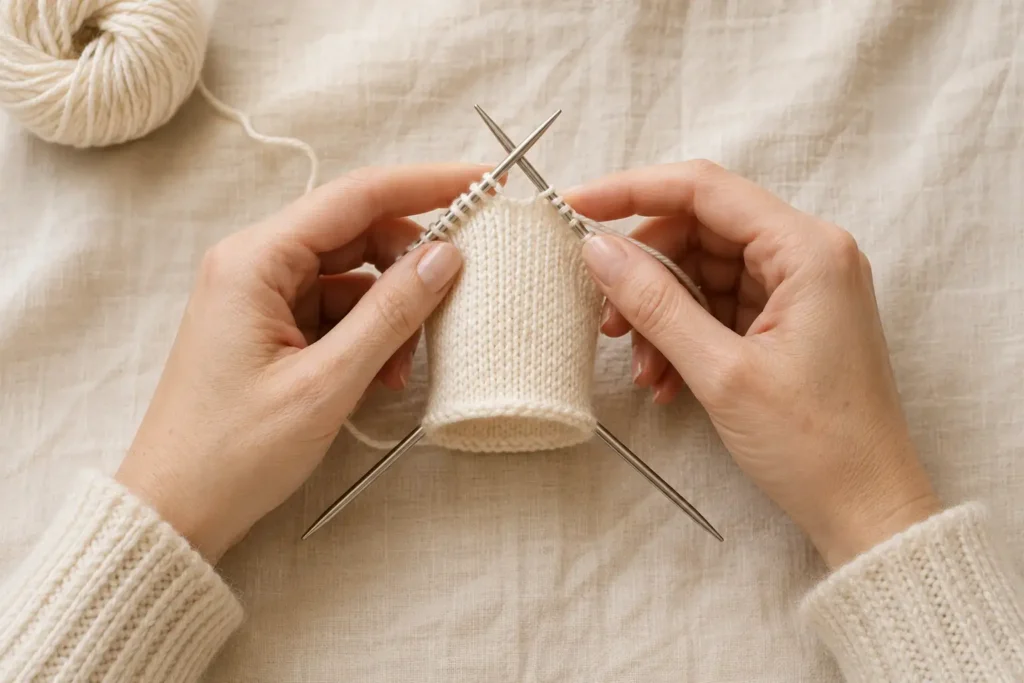
Getting started with DPNs feels awkward at first. The needles fan out like a porcupine, and it’s hard to see where the work begins. But after a few rounds, it becomes natural. Here’s the step-by-step process:
Step 1: Cast on your stitches.
Cast all stitches onto a single DPN first, as you would with any other needle. Use any cast-on method you prefer — long-tail cast-on works well.
Step 2: Divide stitches across needles.
Slip stitches evenly onto 3 or 4 needles (leaving one needle free to work with). For example, 60 stitches ÷ 3 needles = 20 stitches per needle.
Step 3: Join in the round.
Arrange the needles into a triangle (3 needles) or square (4 needles). Make sure no stitches are twisted around the needle. Place a stitch marker to mark the beginning of the round.
Step 4: Work around the needles.
Insert the free (working) needle into the first stitch on the left needle. Knit across all stitches on that needle. When it is empty, it becomes your new working needle. Move to the next needle and repeat.
Step 5: Complete the project.
Continue working rounds. Add shaping decreases or increases as your pattern requires. Finish with a three-needle bind-off, Kitchener stitch, or standard bind-off as the pattern specifies.
Beginner tip: Leave the needles you aren’t working with resting against your palm. A rubber band or point protectors on the unused tips prevent stitches from sliding off.
How Many Needles Are Used?
Most DPN sets come with either four or five needles. Both methods work — the difference is how many needles hold stitches at once.
| Method | Needles Holding Stitches | Working Needle | Arrangement |
|---|---|---|---|
| Four-needle method | 3 | 1 | Triangle |
| Five-needle method | 4 | 1 | Square |
Four-Needle Method
This is the most common setup. Stitches divide across 3 needles, and the 4th is used to knit. The triangle shape is compact and stable. It’s slightly easier for beginners because there are fewer needles to manage.
Five-Needle Method
This setup divides stitches across 4 needles, with the 5th as the working needle. The square arrangement can make stitch counting more symmetrical — useful for patterns that divide into 4 equal sections, such as mittens with a centered thumb gusset.
Double Pointed Needle Sizes
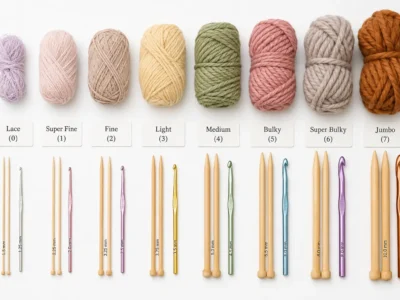
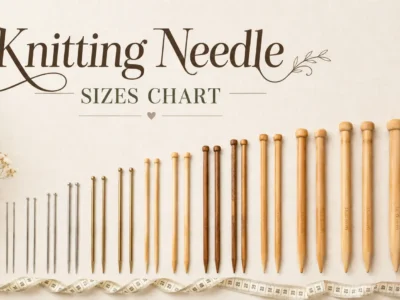
Choosing the right needle size depends on your yarn weight. Use the table below as a starting point, then swatch to confirm your gauge matches the pattern. For precise sizing guidance, use GaugeGenie’s free Knitting Needle Size Chart and Needle Size Conversion Chart.
| US Size | Metric (mm) | Common Uses |
|---|---|---|
| 0 | 2.0 mm | Lace weight socks, fine fingering |
| 1 | 2.25 mm | Fingering weight socks, baby items |
| 1.5 | 2.5 mm | Fingering weight socks |
| 2 | 2.75 mm | Sport weight socks, light gloves |
| 3 | 3.25 mm | DK weight mittens, baby hats |
| 4 | 3.5 mm | DK weight sleeves, small hats |
| 5 | 3.75 mm | Worsted weight projects |
| 6 | 4.0 mm | Worsted weight mittens |
| 7 | 4.5 mm | Aran weight small circumferences |
| 8 | 5.0 mm | Bulky baby items, thick mittens |
| 9 | 5.5 mm | Bulky hats, chunky socks |
| 10 | 6.0 mm | Super bulky small items |
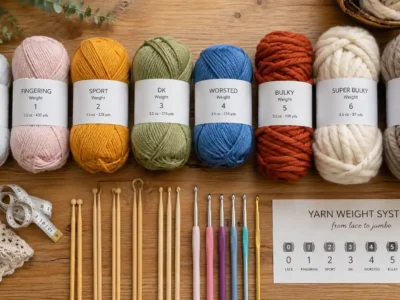
Yarn weight quick reference:
- Fingering/sock yarn → US 0–2 (2.0–2.75 mm)
- DK yarn → US 3–5 (3.25–3.75 mm)
- Worsted yarn → US 6–8 (4.0–5.0 mm)
- Bulky yarn → US 9–11 (5.5–8.0 mm)
To calculate the right needle size for your specific yarn and pattern, use GaugeGenie’s Gauge Calculator and Yarn Weight Calculator.
Materials Used in Double Pointed Knitting Needles
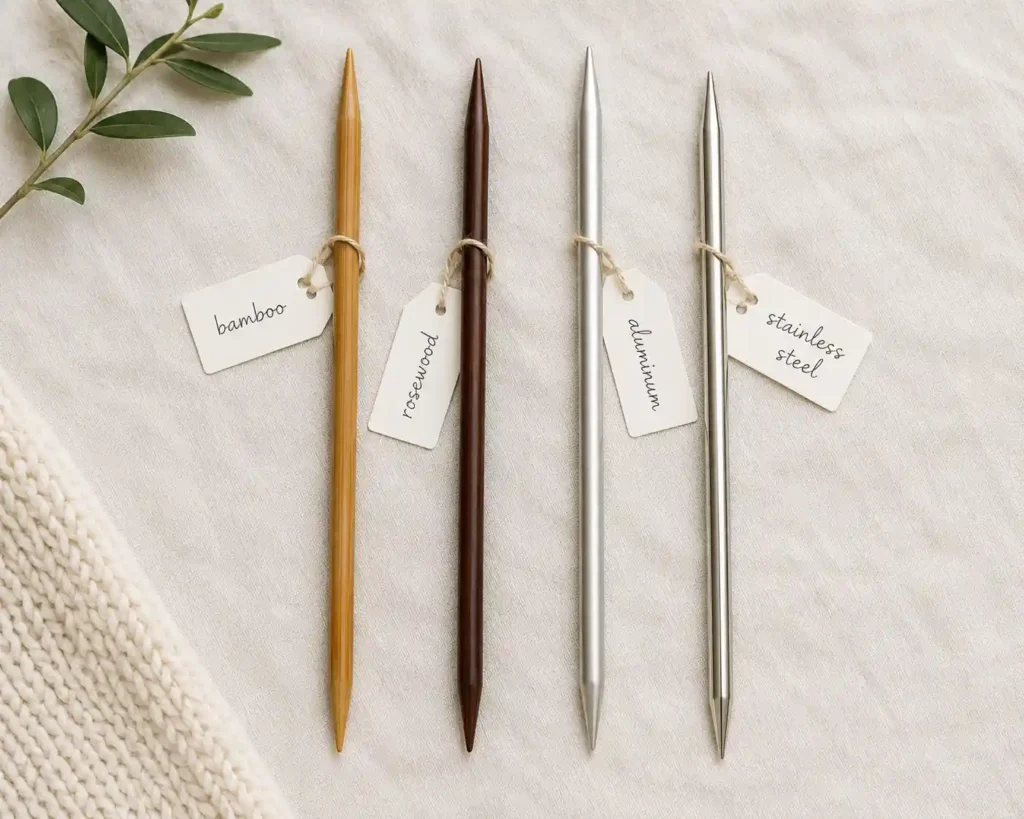
The material of your DPN affects how stitches move along the needle, how the needle feels in your hands, and how long the needle lasts. Here’s a breakdown of the main options:
Bamboo
Bamboo DPNs have a warm, natural feel with light grip. Stitches move a little slower, which actually helps beginners keep stitches from sliding off accidentally. Bamboo is lightweight, quiet, and eco-friendly. It’s the most popular choice for new knitters.
- Grip: High — stitches cling slightly
- Durability: Moderate — can snap at very small sizes
- Speed: Slower — good for beginners
- Best for: Slippery yarns (silk, bamboo), beginners, lace knitting
Wood
Wooden DPNs (birch, rosewood, ebony) behave similarly to bamboo but often feel smoother. They develop a natural patina over time and are beloved by experienced knitters. High-end wood needles like Lantern Moon or Lykke have a luxurious feel.
- Grip: Medium-high
- Durability: Good at standard sizes; fragile at very small gauges
- Speed: Medium
- Best for: Natural fiber yarns, experienced knitters who prefer warmth
Aluminum
Aluminum DPNs are smooth, fast, and affordable. Stitches glide easily, which is great for sticky yarns like wool. They’re lightweight but can feel cold in the hands. Most beginner starter sets are aluminum.
- Grip: Low — very slippery
- Durability: Excellent
- Speed: Fast
- Best for: Wool, cotton, sticky yarns; fast knitters; budget buyers
Stainless Steel
Steel DPNs are the most durable option. They’re heavier than aluminum but essentially indestructible. The smooth surface makes them extremely fast. Popular brands like ChiaoGoo offer stainless steel DPNs in very fine sizes down to US 000 (1.5 mm).
- Grip: Very low — extremely slippery
- Durability: Outstanding
- Speed: Very fast
- Best for: Fine sock yarn, frequent knitters, anyone needing ultra-small sizes
Carbon Fiber
Carbon fiber DPNs are a premium option: extremely lightweight, strong, and with a slightly warm feel. They combine the speed of metal with the grip of bamboo. They’re less common but growing in popularity among sock knitters.
- Grip: Medium
- Durability: Very good
- Speed: Fast
- Best for: High-volume sock knitting, knitters who want speed without full slipperiness
Double Pointed Needles vs Circular Needles
Both tools knit in the round. Choosing between them comes down to project size, personal preference, and experience level.
| Feature | DPNs | Circular Needles |
|---|---|---|
| Learning curve | Steeper — managing multiple needles | Gentler — one continuous needle |
| Portability | Excellent — small, lightweight | Good — cord can tangle |
| Small circumference | Perfect — no minimum stitch count | Limited by shortest cord (usually 9″) |
| Magic loop technique | Not applicable | Excellent — one long circular does everything |
| Dropped needle risk | Higher — more pieces to manage | None |
| Speed (experienced) | Fast | Fast |
| Comfort | Variable — some find it awkward | Generally comfortable |
| Project suitability | Socks, gloves, hat crowns, I-cord | Most in-the-round projects, sweaters |
Many experienced knitters use both: circular needles for sweaters and large hats, and DPNs for socks, glove fingers, and hat crowns. Some knitters also use the magic loop method on long circular needles as an alternative to DPNs. Explore GaugeGenie’s Knitting Calculator to help plan your project.
How to Prevent Laddering
Laddering is a column of loose stitches that forms where one DPN ends and the next begins. It looks like a small ladder running up the side of your work. It happens because the junction between needles creates a slight gap in tension. To prevent laddering, tighten the first two stitches on each new needle by pulling the yarn snugly, and rotate your needle arrangement by one stitch every few rounds so gaps don’t stack up.
What Causes Laddering?
Laddering appears when the transition between needles consistently loosens the yarn. The cause is usually:
- Not pulling tight enough at the start of each needle
- Consistent stitch placement — the same stitches always land at needle junctions
Prevention Tips
- Pull the first stitch firm. When you begin a new needle, tug the working yarn snugly before knitting the first stitch.
- Knit the first two stitches tightly. The first two stitches of each needle are most vulnerable.
- Rotate stitches regularly. Every few rounds, knit one extra stitch past the needle boundary. This shifts the gap so it doesn’t stack.
- Use shorter needles. Shorter DPNs keep the needles tighter together, reducing the gap size.
- Block your finished piece. Light blocking relaxes uneven stitches and evens out tension differences.
Common Beginner Mistakes
Twisted Join
If stitches spiral around a needle when you cast on, your join is twisted. Always lay the work flat and check that all stitches face inward before knitting the first round. A twisted join creates a permanent spiral in the fabric.
Fix: Recount stitches and straighten them before joining. There’s no correction after the first round.
Uneven Stitch Distribution
Beginners sometimes put different numbers of stitches on each needle, which complicates pattern repeats and shaping.
Fix: Count carefully. If your total stitch count doesn’t divide evenly, put the extra stitch on the first or last needle consistently.
Laddering
As explained above, loose tension at needle junctions creates vertical columns of loose stitches.
Fix: Pull the first two stitches of each needle firmly, and rotate your needle position periodically.
Dropped Stitches
With multiple needles in play, stitches can slide off the non-working needles unnoticed.
Fix: Use point protectors on the tips of idle needles. Check your needle tips frequently, especially when setting work down mid-round.
Wrong Needle Size
Using a needle too large results in loose, floppy fabric. Too small means tight, stiff fabric.
Fix: Always swatch first. Use GaugeGenie’s Gauge Calculator to confirm your stitches per inch match the pattern before committing to a full project.
Tips for Knitting Faster With DPNs
Proper Hand Positioning
Hold the working needle like a pencil or in the palm — whichever feels natural. Keep your grip relaxed. Tight hands lead to tight stitches and fatigue.
Needle Management
Push idle needles toward you so they rest in your palm, not sticking out at awkward angles. Some knitters bend the unused needles slightly downward to keep them tidy.
Use Stitch Markers
Place a marker at the start of the round. On longer patterns, place markers at the start of each needle as well. This speeds up counting and catches mistakes early.
Consistent Tension
Tension is the biggest variable for beginners. Practice short swatches before starting a project. Tension evens out naturally with practice.
Build a Practice Routine
Knit 10–15 minutes of plain stockinette on DPNs every day for one week. Repetition is the fastest way to make needle management automatic.
Are Double Pointed Needles Good for Beginners?
Double pointed needles have a reputation for being tricky, but they’re absolutely learnable. Here’s a balanced view:
Double pointed needles are manageable for beginners who start with a simple project, medium-weight yarn, and a little patience. They require more setup than flat knitting, but the technique itself is straightforward once you’ve completed your first round.
Pros for Beginners
- Open up a huge range of projects (socks, mittens, hats)
- Teach good tension habits
- Inexpensive to try (bamboo sets cost under $10)
- Small projects finish quickly, giving a sense of accomplishment
Cons for Beginners
- Managing 4–5 needles simultaneously feels chaotic at first
- Dropped needles are a real frustration
- Laddering takes practice to prevent
Learning Curve
Most knitters feel comfortable with DPNs after 2–3 complete small projects. The first project (usually a small hat or finger puppet) is the hardest. The second is much easier.
Best Beginner Projects
- I-cord — just 3–4 stitches, forces you to learn the DPN motion quickly
- Baby hat — small, fast, simple shaping
- Basic mittens (no thumb) — a small tube from cuff to tip
Frequently Asked Questions
What are double pointed knitting needles used for?
Double pointed knitting needles are used for knitting small circumferences in the round without seams. Common projects include socks, mittens, gloves, hat crowns, and sleeves. They work where circular needles are too long to fit, typically for anything with fewer than 80 stitches or under 8 inches in diameter.
How many double pointed needles do I need?
A standard DPN set contains 5 needles. You use 3 or 4 needles to hold stitches, with 1 needle free for knitting. You only need 4 needles to complete most projects, but the 5th provides a spare if one breaks or is lost.
Are DPNs better than circular needles?
Neither is universally better. DPNs are the best choice for very small circumferences where no circular needle cable fits. Circular needles (especially using the magic loop method) are more versatile for larger projects. Many knitters own both and choose based on the project.
What size DPNs should I buy first?
Start with US size 1 or 2 (2.25–2.75 mm) for socks, or US size 5–7 (3.75–4.5 mm) for mittens and hats using DK or worsted yarn. A bamboo or wood set in one of these sizes gives you a good foundation. Use GaugeGenie’s Knitting Needle Size Chart to match needle size to your yarn label.
Can beginners learn double pointed knitting?
Yes. Beginners can absolutely learn double pointed knitting. Starting with a simple project — like I-cord or a baby hat — in a medium-weight yarn makes the learning curve manageable. Expect the first few rounds to feel awkward; the motion becomes natural quickly with practice.
How do I stop laddering when using DPNs?
To stop laddering, pull the working yarn snugly on the first two stitches of each new needle. Every 3–5 rounds, knit one stitch past the needle boundary to rotate where the gap falls. Light blocking at the end of the project also reduces the appearance of any remaining unevenness.
Key Takeaways
- Double pointed knitting needles are short, double-ended needles used in sets of 4 or 5 for small-circumference knitting.
- They’re ideal for socks, mittens, gloves, hat crowns, baby items, and sleeves.
- Most sets use either 3 needles to hold stitches (four-needle method) or 4 needles (five-needle method).
- Needle sizes range from US 0 (2.0 mm) for fine sock yarn to US 10+ for bulky projects.
- Materials include bamboo (best for beginners), wood, aluminum, stainless steel, and carbon fiber.
- Laddering is the most common problem — prevent it by tightening junction stitches and rotating needle positions.
- Beginners can learn DPNs; start with I-cord or a baby hat in medium-weight yarn.
Conclusion
Double pointed knitting needles are an essential part of any knitter’s toolkit. They open the door to seamless socks, mittens, hats, and dozens of small tubular projects that simply aren’t possible with flat needles or full-sized circulars. Once you get past the initial setup, working with DPNs becomes fast, intuitive, and deeply satisfying.
Whether you choose bamboo for a beginner’s grip or stainless steel for high-speed sock production, the right DPN set makes a real difference. Start with a simple project, practice consistent tension, and don’t let laddering discourage you — it’s a problem every DPN knitter solves with a little practice.
Use GaugeGenie’s free Knitting Needle Size Chart, Gauge Calculator, and Yarn Weight Calculator to choose the perfect needle size for your next knitting project.
Join the GaugeGenie Crafting Community
Follow us for knitting inspiration, yarn resources, pattern tips, and free calculator updates.