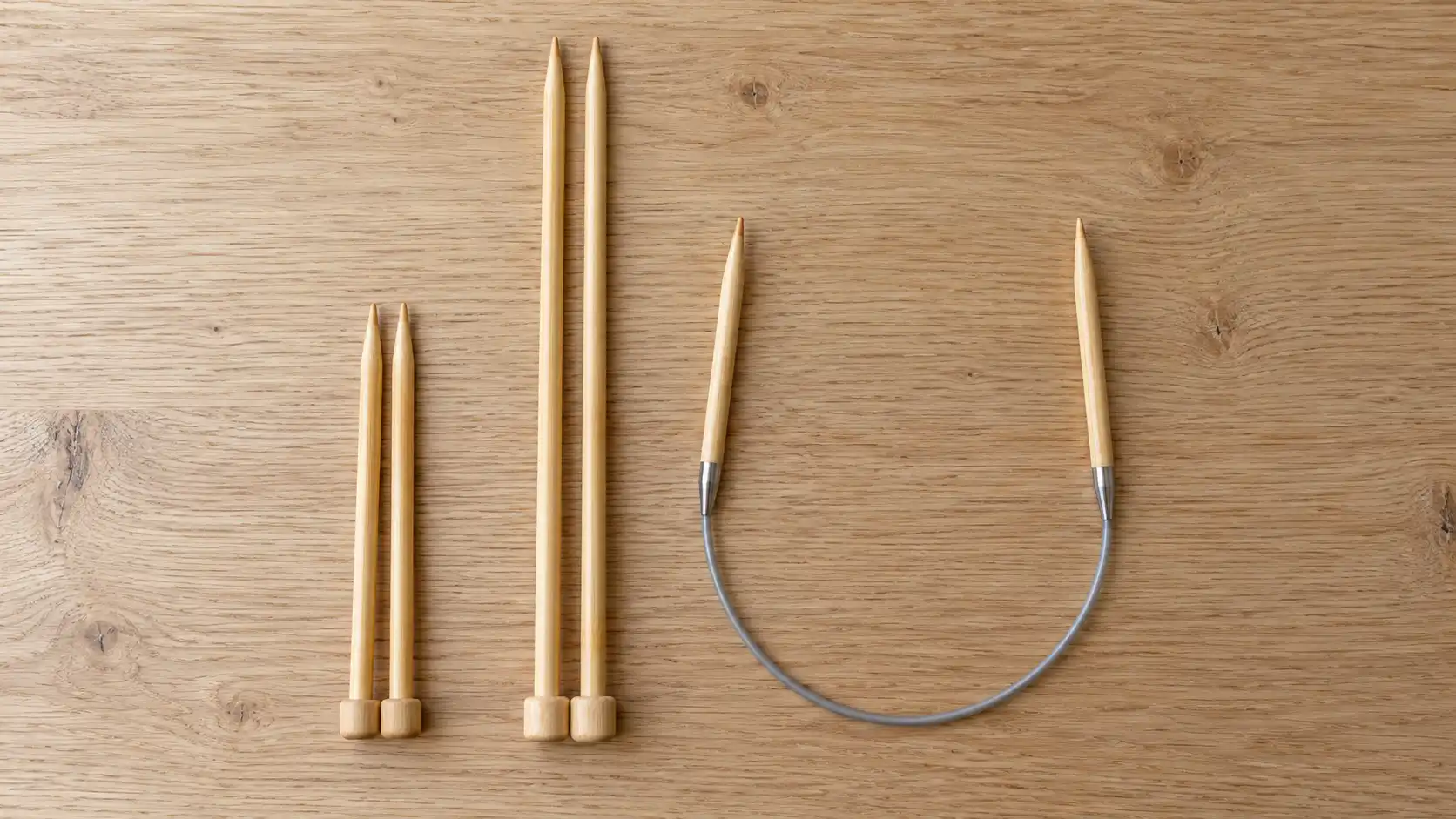
How long should knitting needles be? Long enough to hold the work comfortably, and short or flexible enough for the way you are knitting it. For a flat piece, think about stitch capacity and handling. For a tube knitted continuously around a circular needle, the assembled needle must work inside that tube without stretching the stitches around an oversized loop.
Needle length and needle size are separate choices. You can have the right diameter for gauge and the wrong length for the project. Here is how to read the measurements and choose a more useful setup.
How long should knitting needles be for your project?
Start with the pattern’s equipment list. A specified circular length may support its construction method, rather than simply describe how much knitting will fit.
| Project or method | What length must allow | Useful first check |
|---|---|---|
| Flat scarf or narrow panel | All stitches fit with room to move | Can you work without crowding or awkwardly long ends? |
| Wide flat blanket | Plenty of stitch capacity | Consider a circular needle used back and forth |
| Hat worked continuously in the round | The tube fits around the assembled circular | Check the pattern’s length and your working circumference |
| Sock, sleeve or hat crown | A method suited to a small or shrinking tube | Check DPNs, short circulars or the pattern’s long-cable method |
| Magic loop | Enough flexible spare cable for the technique | Follow the method’s length and cable requirements |
There is no single needle length that is best for all five situations. The method comes before a shopping-list measurement.
Diameter, tip length and total length are different
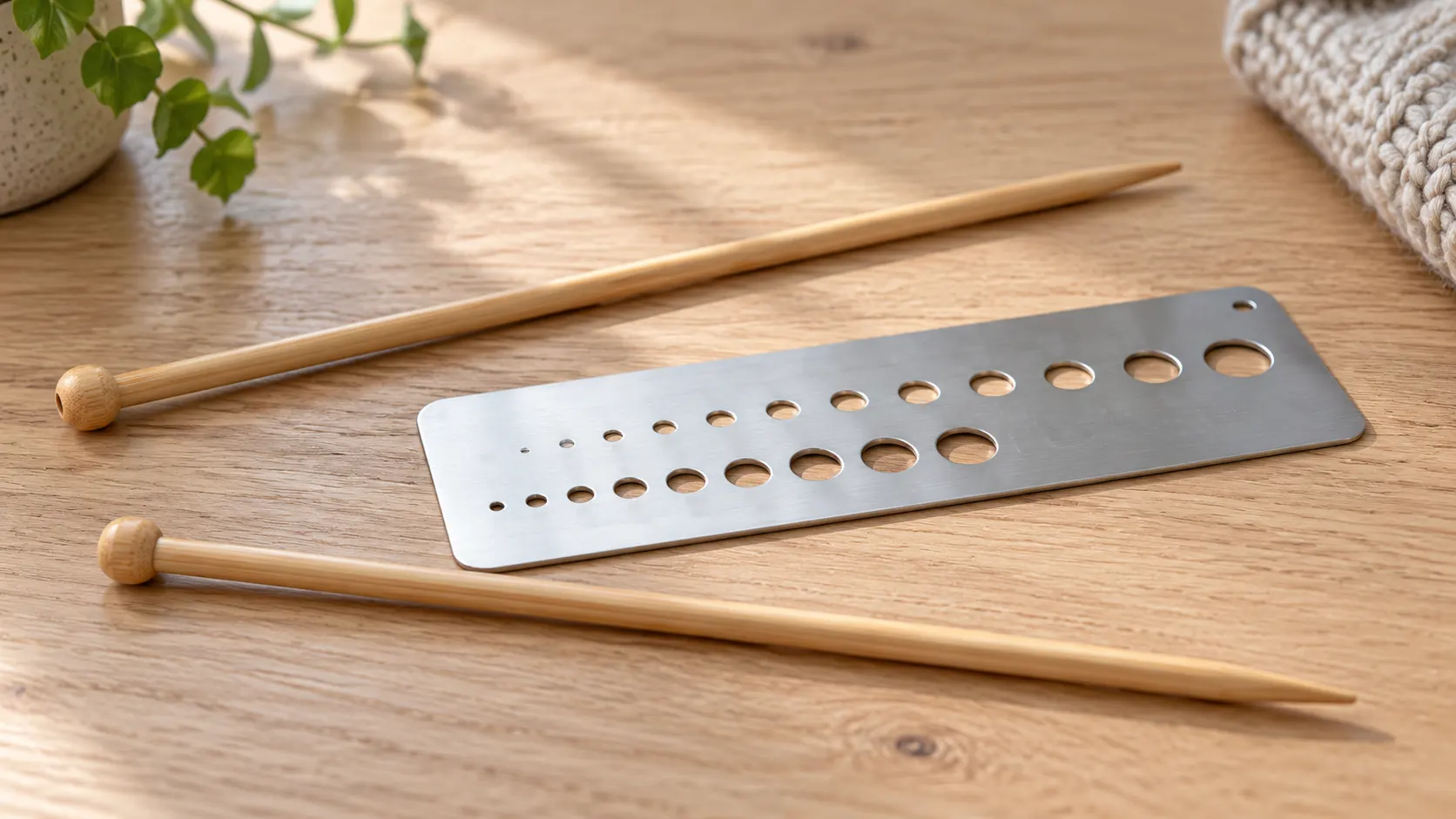
The diameter tells you how thick the working shaft is. It is usually the millimetre number you compare when checking needle size. Length tells you how much tool or assembled circular you have from end to end.
On interchangeable circulars, a third measurement appears: the length of each removable tip. Two tips connect to a cable, making the complete circular assembly.
For diameter conversions, use the knitting needle sizes chart. Keep that task separate from choosing a cable or deciding whether straight needles feel comfortable in your hands.
How circular needle length is measured
A complete circular needle is measured tip to tip along the assembly, including both needle tips and the cable. It is not the straight-line gap between two tips when the cable is curled on a table.
Lay the assembly out gently and follow its path with a flexible measuring tape. Do not stretch a cable under tension to make it reach a label’s number. Product lengths may be nominal, and paired labels such as 40 cm / 16 inches are conventional approximations rather than exact conversions.
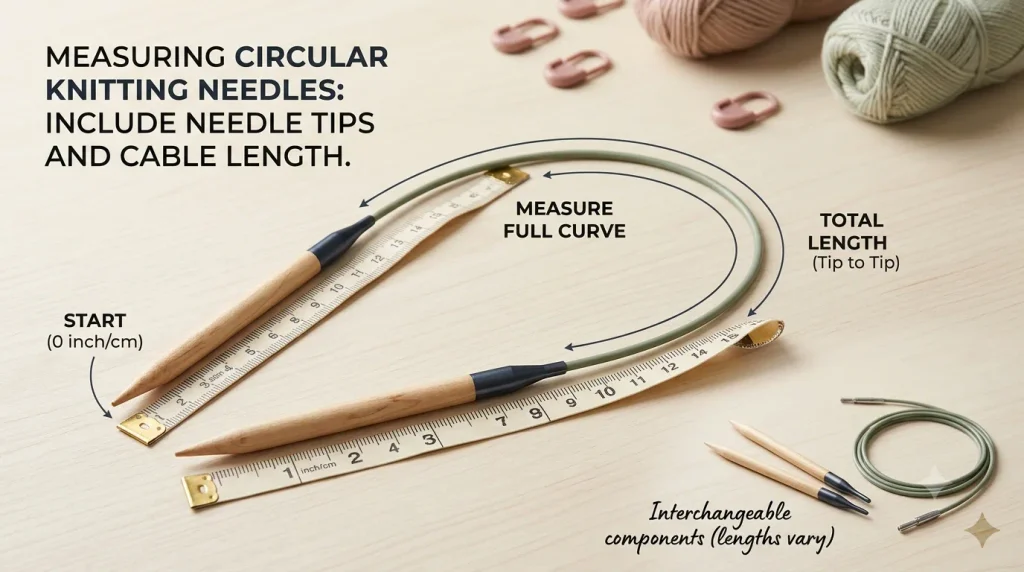
Check whether a spare cable label includes the tips
This is where interchangeable systems become confusing. A cable’s advertised number can refer to the finished assembly in one system and the cable component in another.
For example, the KnitPro product catalogue explains its relevant cable length as tip-to-tip when assembled with needles. By contrast, the ChiaoGoo TWIST and SPIN guide provides a chart combining component cables and tips: two 4-inch tips plus an 8-inch cable make a nominal 16-inch circular.
Read the instructions for the exact system and tip length you own. Do not add two tips again if the listed length already describes the finished circular. Also check connector compatibility and the maker’s minimum cable-and-tip combinations; not every short cable can be used with every long tip.
Choosing a length for flat knitting
Straight needles need enough usable space to hold the stitches while leaving room near the tip to work. A rigid needle that feels cumbersome for a narrow scarf may be manageable for another knitter or another project. Comfort is part of the decision.
If the work feels crowded, do not force every stitch onto the last few centimetres of a straight needle. Consider a longer suitable needle or a circular with enough cable capacity.
You can knit a flat piece on circular needles without joining it into a round. Work across, turn, and work back as the pattern instructs. The cable holds the stitches between turns, which can be useful for a wide panel or blanket.
A circular used flat does not need to match the finished width exactly. It needs to hold the stitches without forcing them off the tips or bunching them so tightly that you struggle to move them. Very long unused cable can also be inconvenient for a small piece, so test the setup before committing to a large cast-on.
Choosing a length for ordinary knitting in the round
For continuous circular knitting, the stitches must travel comfortably around the full needle. An assembly that is longer than the tube’s working circumference asks the fabric to stretch simply to complete the round.
A hypothetical example: a hat body is intended to work at a 50 cm circumference. A nominal 40 cm circular may be a workable starting setup if the pattern calls for it. A nominal 80 cm circular will not behave the same way for ordinary continuous rounds; you would need a suitable technique using excess cable, or a different setup.
These are illustrative dimensions, not a universal hat recommendation. Check the pattern, actual fabric and tip compatibility. When the crown decreases, the working circumference gets smaller, so plan the method for that stage too.
Do not use an oversized circular to hold the fabric stretched out and then judge the fit or gauge in that state. Measure the fabric without that artificial stretch.
Small tubes: change the method when needed
For socks, narrow sleeves and later crown rounds, consider the method the pattern teaches:
- Double-pointed needles: divide the stitches over several needles, leaving room to work and reducing the risk of stitches slipping off. See the DPN guide.
- A compatible short circular: use tips and a cable intended for that small circumference. Very short tips may feel different in your hands.
- Magic loop or another long-cable method: follow instructions for that technique. It uses excess cable deliberately, rather than forcing a small tube around a large conventional loop.
Do not switch to magic loop halfway through a project solely because the package says circular. Learn the arrangement first on a small practice piece and check that the cable and joins suit it.
What about double-pointed needle length?
With DPNs, consider the number of stitches resting on each needle and how much working room you have between the points. A longer DPN can hold more stitches, but extra length can also get in the way for a small tube.
Choose a manageable length for the method and distribute the stitches as the pattern directs. Recheck that every needle in the set has the intended diameter; matching length does not prove matching size.
Keep point protectors or suitable storage with the set when the work is put away. The best length is still one you can handle without constantly nudging stitches toward an exposed end.
Frequently asked questions
Do knitting needles come in different lengths?
Yes. Straight needles, DPNs and circular assemblies are available in different lengths. The usable choice depends on the project, technique, tip system and your handling preferences.
Does circular needle length include both tips?
The complete assembly is measured tip to tip, including both tips. A spare interchangeable cable listing may use a different labelling convention, so read that manufacturer’s description before choosing a component.
Can I knit a scarf on circular needles?
Yes. Work flat by turning at the end of each row instead of joining into a tube. Choose enough capacity for the stitches and use the diameter that gives the required fabric.
Can I knit a hat on a long circular needle?
It depends on the method. A long circular may suit magic loop, while ordinary continuous circular knitting requires a loop that works within the tube’s circumference. Follow the pattern’s technique and length instructions.
Does changing needle length change the required gauge?
The pattern’s required gauge stays the same. Your handling may change with a new setup, so check a sample using the actual needles and method you plan to use.
Should the cable be as wide as the finished blanket?
Not necessarily. When knitting flat, the stitches can sit along the cable rather than holding the blanket fully spread. Choose enough practical capacity and working room, then check that stitches move comfortably.
Check the setup before a large cast-on
Confirm the diameter, assembled length, tip compatibility and knitting method. Make your sample with that setup; for a round project, our swatching in the round guide explains how to make it representative.