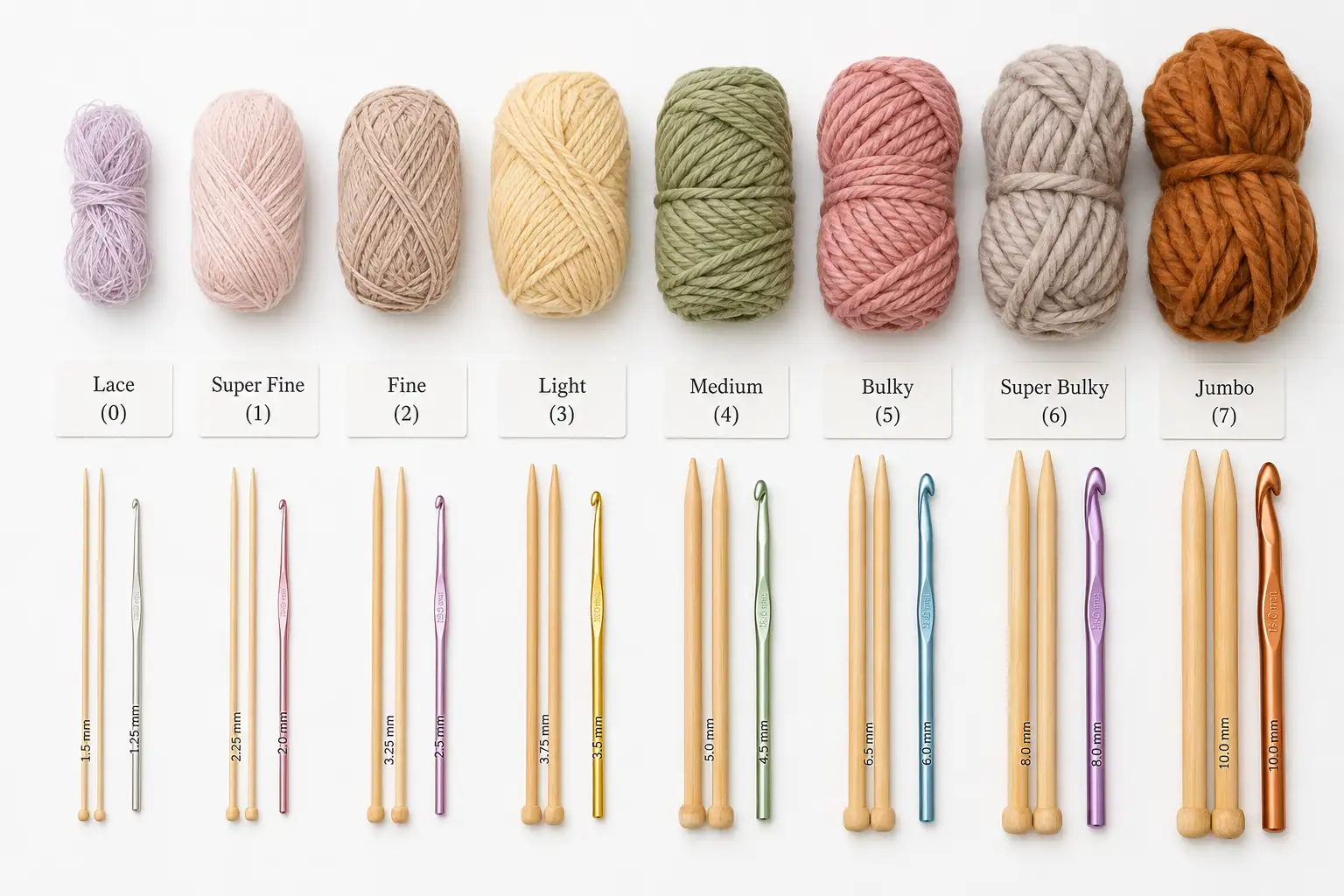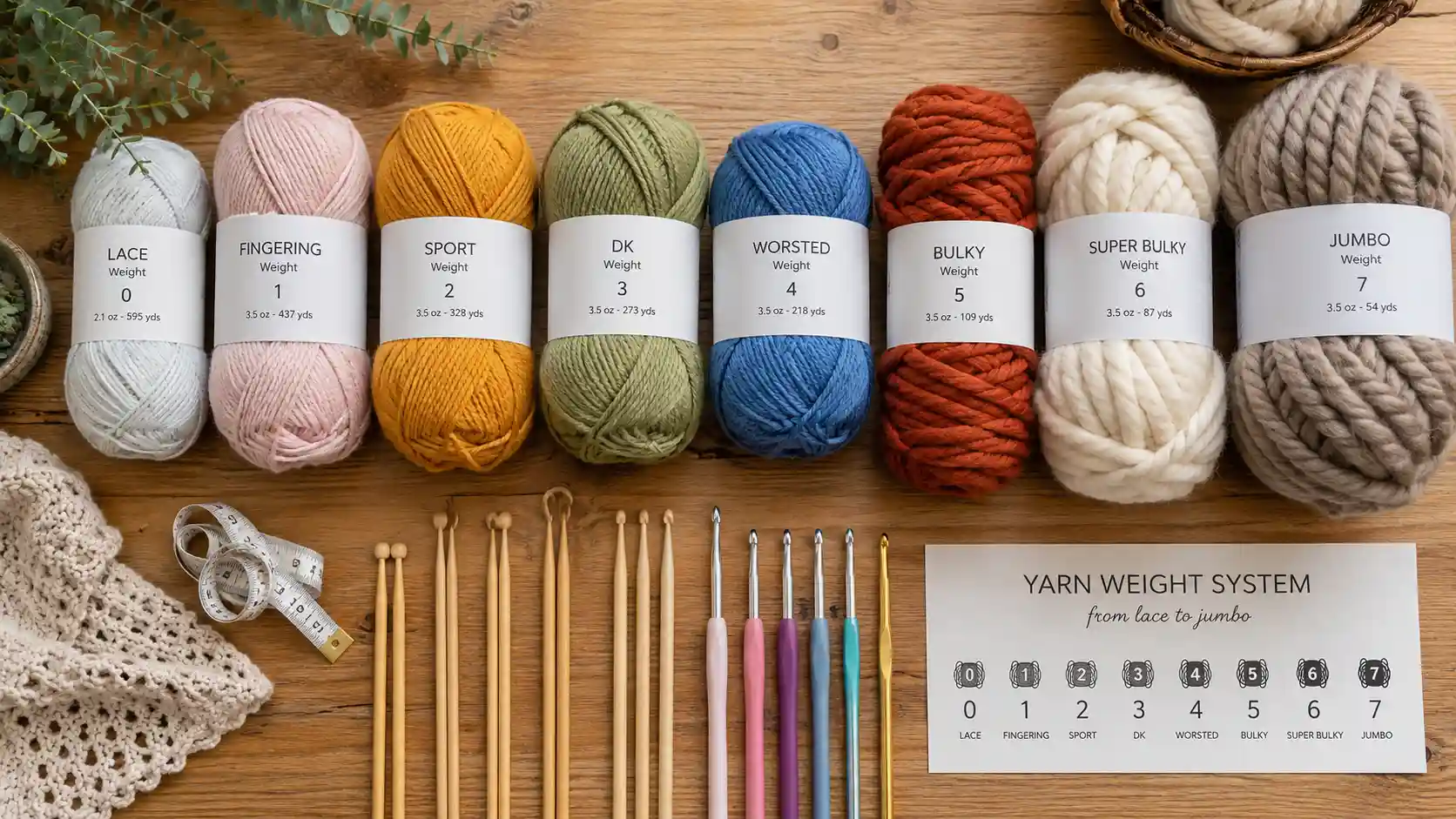
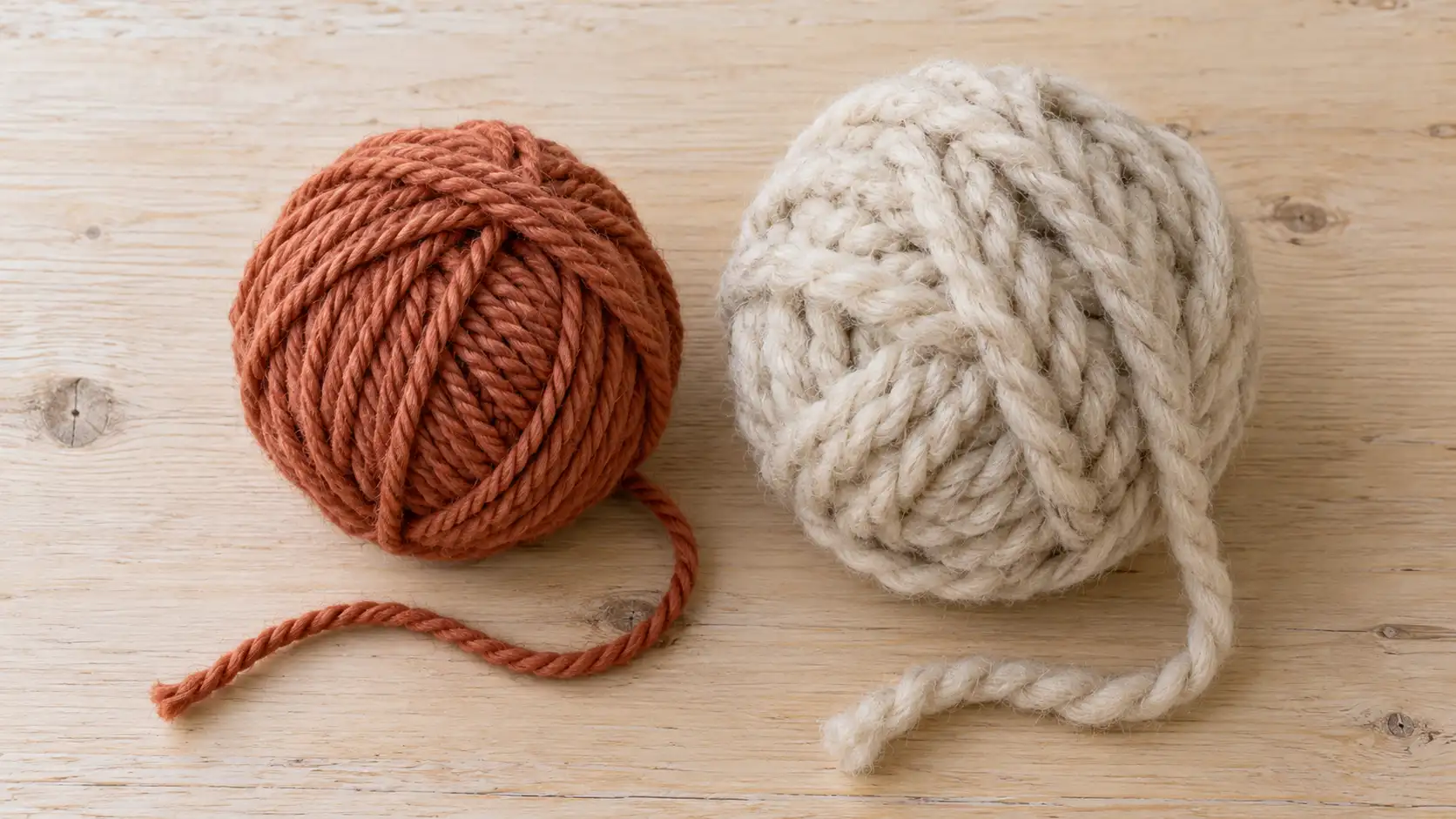
What weight is chunky yarn? In the Craft Yarn Council system, chunky is commonly associated with 5 / Bulky. Super chunky usually points to 6 / Super Bulky. Check the label, though: the word on the front of a ball band is a useful clue, not a complete specification for substituting yarn.
The distinction matters when a pattern calls for one and your stash contains the other. You may be able to make fabric you like with both, but the same stitch count will not necessarily make the same size.
What weight is chunky yarn on the standard chart?
The Craft Yarn Council’s standard yarn weight system provides these broad knitting guidelines:
| Label group | CYC number | Stockinette stitches over 4 inches | Needle range |
|---|---|---|---|
| Bulky / chunky | 5 | 12–15 | 5.5–8 mm |
| Super bulky / super chunky | 6 | 7–11 | 8–12.75 mm |
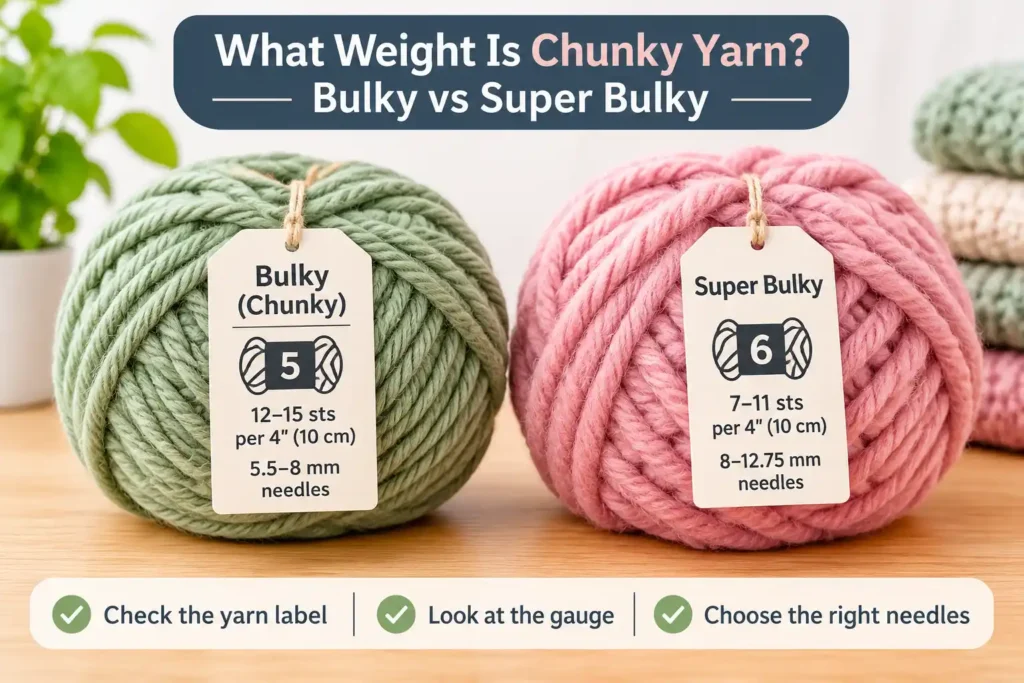
These ranges describe categories. They are not instructions to use any needle in the row and expect a pattern to fit. The pattern’s stitch, gauge and intended fabric still take priority.
If you are comparing the whole range from lace to jumbo, use our yarn weight guide. Here, the task is narrower: deciding which of these thicker groups you have and whether it suits your pattern.
Chunky, bulky and super chunky: read the whole label
You will often encounter chunky and super chunky in UK yarn descriptions, and bulky and super bulky alongside numbered categories in US and Canadian listings. Australian labels may also use regional ply terminology. These naming habits help you search, but they do not establish an exact match between two products.
Before substituting, compare four things:
- Weight group: the number or name attached to that specific yarn.
- Reference gauge: the stitch count, measuring distance and stitch pattern.
- Needle recommendation: a starting point for that yarn, not a guarantee for your hands.
- Fibre and construction: whether the yarn is smooth, fluffy, loosely spun, dense or differently structured from the original.
Do not try to prove a yarn is bulky by counting strands. A traditional ply name and the number of strands visible in a modern yarn are not interchangeable measurements.
Two real label examples show the difference
The following are published maker specifications, checked on 28 October 2026. They are reference examples, not results from knitting or testing these products ourselves.
| Maker’s yarn | Ball quantity | Suggested knitting needle | Published gauge over 10 cm / 4 inches |
|---|---|---|---|
| Stylecraft Special Chunky | 100 g / 144 m | 6 mm | 14 stitches × 20 rows |
| Stylecraft Special XL, labelled Super Chunky | 200 g / 136 m | 10 mm | 9 stitches × 12 rows |
Sources: Stylecraft Special Chunky and Stylecraft Special XL.
Notice that the larger 200 g ball contains slightly less length in this comparison. Package mass and yarn thickness are different pieces of information. Two balls can look substantial on a shelf and still offer very different amounts of knitting length.
Use the current band on the yarn you actually own if its specification differs from an online listing. When a label pairs 10 cm with 4 inches, measure using the reference unit required by your pattern; those two distances are close, but not identical.
Can you use super bulky instead of bulky yarn?
Sometimes, but it is a substitution to work through, not a direct swap. First make a washed sample in the pattern’s stitch. Compare both the measured gauge and the feel of the fabric.
A hypothetical example makes the sizing risk easier to see. A pattern uses 60 stitches at 12 stitches per 10 cm. That produces a width of 50 cm. If your substitute produces 10 stitches per 10 cm, those same 60 stitches make 60 cm. The result is 10 cm wider before considering seams or shaping.
The calculation is:
Width = stitch count ÷ stitches per centimetre.
You can use the gauge calculator with your own measured counts. It helps with the arithmetic; it does not decide whether the substitute fabric has the drape, recovery or stability the design needs.
For a simple scarf or rectangle
If the design is a plain rectangle, you may have room to choose a different stitch count for your desired width. Keep any stitch-pattern multiple and edge stitches intact. Work to a measured length if the instructions allow it, and reassess the yarn quantity.
For a fitted sweater, hat or shaped item
Be more cautious when several dimensions depend on gauge. A different stitch count affects shaping, repeats and placement. A larger or smaller pattern size is not automatically a complete solution because its lengths and proportions may also change.
Choose a yarn that makes suitable fabric at the required gauge, or use a pattern designed for the substitute’s gauge. If you reach stitch gauge but not row gauge, read our guide to mismatched row gauge before changing shaping instructions.
What size needles should you use for chunky wool?
Start with the knitting needle in your pattern. If you have no pattern, start with the yarn’s own label and make a sample for the fabric you want.
The broad category ranges above help narrow the first choice, but they are not universal needle rules. A close fabric for one project and an open fabric for another can require different choices with the same yarn.
Check that you are reading a knitting needle recommendation rather than a crochet hook size. For a US or older UK number, use the needle size conversion chart to find the millimetre diameter.
If the washed sample has too many stitches over the measuring distance, try a larger needle. If it has too few, try a smaller one. Make and measure a fresh sample rather than assuming a single size change will be enough.
Does holding two strands together make chunky yarn?
Holding yarn double creates a combined strand, but it does not produce a guaranteed category. Two DK yarns, for example, are not a formula that promises a particular chunky gauge in every fibre and construction.
Sample with both strands held together, using the stitch and washing method intended for the project. Check that you can keep both strands in each stitch and that you like the resulting fabric.
Plan quantities in length, too. If a project needs 150 m of a combined two-strand yarn, you need 150 m of each strand, or 300 m of the original yarn in total when both strands are the same product. That is an illustrative calculation, excluding any extra allowance or swatching yarn.
Check quantity after you choose the fabric
Do not buy the same number of balls simply because the pattern’s yarn and your substitute both say chunky. Compare the metres or yards per ball, then check the length required for the relevant size.
Our yarn yardage calculator guide explains project planning in more detail. Use a consistent length unit, round whole balls up when purchasing, and account for the sample and any changes to the design. An allowance reduces uncertainty; it cannot guarantee that every altered project will use the predicted amount.
Frequently asked questions
Is chunky yarn number 5 or number 6?
Chunky commonly corresponds to bulky, number 5. Super chunky commonly corresponds to super bulky, number 6. Confirm the specific manufacturer’s category and gauge rather than relying on the word alone.
Are bulky and super bulky the same?
No. They are separate CYC categories. A pattern written for one may not fit or behave as intended when you substitute the other without checking gauge and fabric.
Is chunky yarn the same as worsted or Aran?
Do not treat them as interchangeable names. Compare the actual yarn specifications and the pattern’s required gauge before replacing one with another.
Can I identify chunky yarn by its ball weight?
No. A 100 g ball tells you the package’s yarn mass. It does not establish the thickness category. Read the category, length and gauge information as separate details.
Can I use chunky yarn for a beginner project?
Choose a pattern whose stitches, construction and finishing suit your experience. Yarn thickness alone does not decide whether instructions are easy to follow. Check that your chosen yarn makes the fabric the pattern requires.
Will larger needles turn a bulky yarn into super bulky?
They may change the fabric and gauge, but they do not change the original yarn into a different product category. Judge the sample rather than relabelling the yarn to fit the pattern.
A useful note to keep with the yarn
Save the ball band and write down the needle, stitch pattern and washed gauge you actually used. When you return to the project, that small record tells you more than the word chunky on its own.