
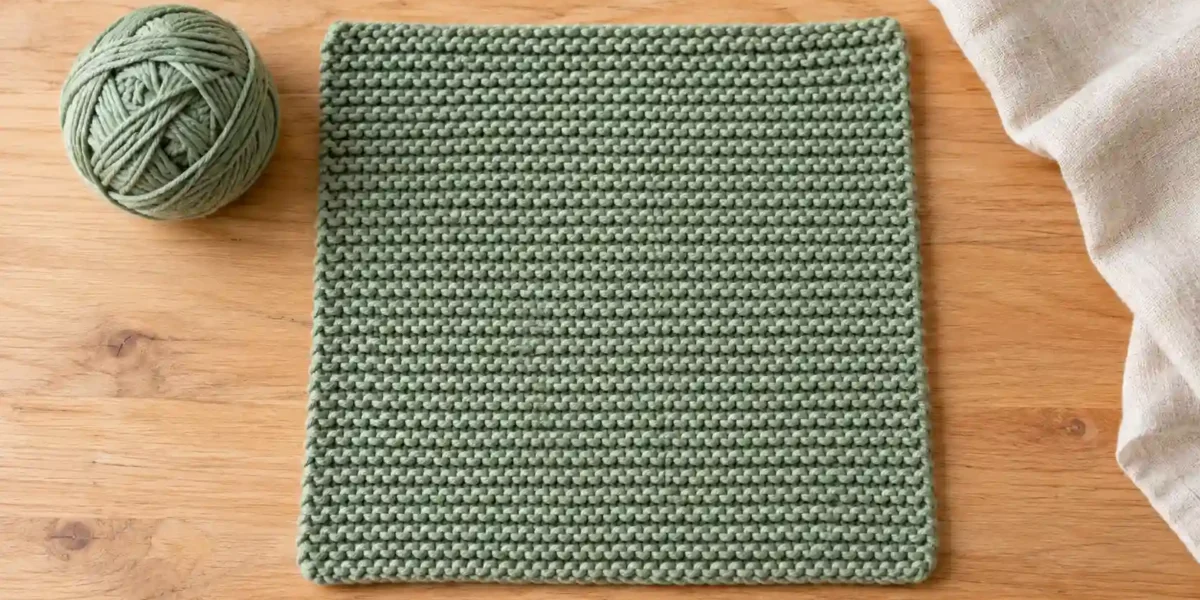
This free garter stitch dishcloth pattern turns the knit stitch into a useful cotton square. There is no diagonal shaping, no border to pick up and no seam. Choose a small cloth for wiping around taps, a medium everyday cloth or a larger square for washing up.
You work back and forth on straight needles, knitting every row. The size table gives both rows and garter ridges, so you can check your progress without guessing whether one ridge means one row.
Design note: Stitch counts and sizing calculations have been checked, but this new pattern has not yet been sample knitted. Yarn quantities are planning allowances, not measured consumption. The featured image is an AI-generated design visualization, not a photograph of a test-knit sample.
Garter stitch dishcloth pattern at a glance
| Detail | Pattern information |
|---|---|
| Skill level | Beginner: cast on, knit, bind off |
| Construction | One flat square; no shaping or sewing |
| Yarn | Smooth medium-weight cotton, Category 4 |
| Starting needle | 4.5 mm / US 7; adjust for your fabric |
| Reference gauge | 20 stitches and 40 rows over 10 cm in washed garter stitch |
| Sizes | 15, 18 or 22 cm square / about 6, 7 or 8¾ in |
Ten centimetres is approximately four inches; all calculations below use the metric measurement. The finished dimensions are targets at the stated washed gauge, not a promise that every cotton yarn will behave identically.
Materials and yarn choice
Choose a smooth, firmly plied cotton that lets you see individual stitches. A pale or medium solid colour is easier to read than black, fuzzy yarn or a busy print. For an everyday kitchen cloth, check that you are comfortable with the yarn label’s washing instructions before buying it.
- Small cloth: allow 45 m / about 50 yd.
- Medium cloth: allow 60 m / about 66 yd.
- Large cloth: allow 85 m / about 93 yd.
- Allow another 20 m / about 22 yd for a swatch if that yarn will not be reused.
- Straight needles, a blunt yarn needle, scissors and a tape measure.
These are deliberately separate allowances for the project and swatch. Skein size varies, so compare metres or yards on the label rather than assuming one ball always covers every size. The beginner’s yarn guide explains how fibre and construction affect a project.
This is a washing cloth, not a tested heat-protective potholder. Its fibre content and thickness do not establish protection from hot cookware.
Choose your size and check gauge
| Size | Target washed square | Cast on | Knit rows |
|---|---|---|---|
| Small | 15 cm / 5.9 in | 30 stitches | 60 rows |
| Medium | 18 cm / 7.1 in | 36 stitches | 72 rows |
| Large | 22 cm / 8.7 in | 44 stitches | 88 rows |
Make a swatch a little larger than 10 cm, wash it as you intend to wash the cloth and let it dry without stretching. Measure the central fabric. The reference is 20 stitches and 40 rows in 10 cm, equivalent to 20 garter ridges in that height. The cast-on and bind-off edges add a small amount to the real overall measurement.
For this project, a different gauge is usually a size choice rather than a disaster. A fabric you like matters more than forcing a particular needle size. If you need an exact square, use the washed gauge to calculate a revised cast-on and row count with the gauge calculator.
For example, at 18 stitches and 36 rows per 10 cm, an 18 cm square needs about 32 stitches and 65 rows after rounding to whole numbers. That is a different specification from the medium size in the table; do not combine the new stitch count with its original 72 rows.
Abbreviations and counting
- k: knit.
- st / sts: stitch / stitches.
- CO: cast on.
- BO: bind off, also called cast off.
- Garter ridge: the raised horizontal line made by two knitted rows.
Every row is a knit row. You do not alternate knit rows with purl rows; that would make stockinette rather than garter stitch. This pattern does not slip its edge stitches. Knitting the first and last stitch normally keeps the written count straightforward.
Do not include casting on or binding off in the listed knit-row total. For a closer look at reading the fabric, see how to count rows in knitting.
Full pattern: knit the cotton square
1. Cast on
Cast on 30 (36, 44) stitches for the small (medium, large) cloth. A knitted cast-on or a long-tail cast-on is suitable. Keep it comfortable rather than tight. If you start with a slipknot, it counts as the first stitch.
Count the loops on the needle before you begin. Place a removable marker near one corner after the first few rows if you want a simple reference for the starting edge.
2. Knit every row
Row 1: Knit every stitch to the end. Turn the work.
Every following row: Knit every stitch to the end, then turn.
Continue until you have completed 60 (72, 88) knit rows in total. You should still have 30 (36, 44) stitches. At the reference gauge, this makes the planned square before the finishing edges are taken into account.
As a second counting check, the totals correspond to 30 (36, 44) two-row garter ridges. Edge appearance can make the first ridge awkward to read, so record rows as you work and use the ridges as a check. The free stitch counter can keep the running total.
If your washed swatch has a different row gauge, work to the required length using that information instead of insisting on the reference row total. Measure the work laid flat without pulling it taller.
3. Bind off
Bind off knitwise with a relaxed tension: knit two stitches, lift the first over the second, knit the next stitch and repeat. When one loop remains, cut the yarn with a tail of about 15 cm / 6 in, pull it through the last loop and secure it gently.
The top edge should sit comfortably against the fabric. A tight bind-off can make an otherwise square cloth pull in at that end.
4. Finish and wash
Weave the ends through the backs of several stitches, changing direction so they are less likely to pull out. Avoid a hard knot in the middle of the wiping surface.
Wash according to the yarn label, lay the cloth into a square and let it dry. Do not stretch it to force the table measurement. Record its actual size and yarn use if you plan to make a matching set.
Small changes that keep the pattern simple
For a wider cloth, cast on more stitches; for a taller one, work more rows. At the reference gauge, adding two stitches adds about 1 cm of width. Adding four rows adds about 1 cm of height. There is no stitch repeat to preserve.
If you want stripes, change colour at the beginning of a row and knit an even number of rows in each colour to keep the visible colour transitions on the same face. Each change creates more ends to weave in. Finish a plain cloth first if you are still learning to keep the edges steady.
Troubleshooting
The edges keep getting wider
Count the stitches. Working twice into the first loop or accidentally wrapping the yarn over the needle can add a stitch. If the count is wrong, find the extra loop before continuing. Stretching or blocking will not correct a changing stitch count.
The cloth is a rectangle
Check stitches and rows separately. Garter stitch needs roughly twice as many rows as stitches at this particular reference gauge, but that is not a universal rule. A different yarn or tension can change the relationship.
The top edge is narrower
That usually points to a tight bind-off. Before cutting a very short tail, check that the edge can spread to the same width as the fabric. Use a looser hand or a larger needle for the bind-off if needed.
Frequently asked questions
Can I make this without purling?
Yes. The fabric is made by knitting every row. You only need to cast on, knit, turn and bind off.
Is a garter ridge one row or two?
Two rows. The medium cloth’s 72 knitted rows correspond to 36 two-row ridges. Do not stop at 36 rows unless you intentionally want a shorter piece.
Can I use DK cotton instead of worsted cotton?
Yes, if you like the resulting fabric, but check the washed gauge and recalculate the size. DK and medium-weight cotton should not be treated as interchangeable simply because both are cotton. The yarn weight chart is a useful starting guide.
Should I stretch the cloth while measuring it?
No. Lay it flat in its relaxed state. Stretching garter stitch can make the measurements misleading, especially before washing.
Can I knit a set in different sizes?
Yes. Keep a note of the yarn, needle, cast-on, row total and finished washed size for each cloth. That makes the next one much easier to reproduce.
Keep your next project manageable
Save the yarn label and your finished measurements with the pattern. Then visit the free knitting pattern library for the next project as new designs are added.
Conventional abbreviation meanings follow the Craft Yarn Council knitting abbreviations. The size choices and instructions above were written for this Gauge Genie draft.