Knitting gauge calculator tools have completely changed the way knitters approach their projects — and if you’ve ever ended up with a sweater two sizes too big or a scarf that’s barely wide enough, you already know why gauge matters more than almost anything else in knitting.
Whether you’re a beginner just figuring out tension or a seasoned knitter working on a complex pattern, understanding and calculating your gauge is the single most important step before casting on a single stitch. In this guide, we’ll walk you through everything you need to know about gauge — and show you how to use our free knitting gauge calculator to take all the guesswork out of the process.
Stop Guessing. Start Knitting with
Confidence.
Our free knitting gauge calculator instantly gives you exact stitch counts, row counts, ease adjustments, and yarn estimates — so your project comes out perfectly sized, every single time.
🔒 100% free · Works in inches & centimeters · Instant results
What Is Knitting Gauge and Why Does It Matter?
Before we dive into how to use a knitting gauge calculator, let’s get clear on what gauge actually means. In knitting, gauge refers to the number of stitches and rows you produce per a given measurement — typically 4 inches (10 cm). This number is shaped by three things: your yarn weight, your needle size, and your personal knitting tension.
No two knitters knit exactly the same way. Even if you and your friend are both using the same yarn and the same needle size, your gauges can differ significantly. One person might knit tightly, producing more stitches per inch, while another knits loosely, producing fewer. This is completely normal — and it’s exactly why every pattern recommends checking your gauge before you begin.
When your gauge is off, your finished project will be off too. A sweater designed for 22 stitches per 4 inches will come out noticeably larger if you’re only hitting 18 stitches per 4 inches. That difference compounds across hundreds of stitches and dozens of rows, turning a planned medium into an accidental extra-large.
That’s where a knitting gauge calculator becomes invaluable. Instead of doing the math yourself — which can get surprisingly complex once you factor in ease, borders, pattern repeats, and yarn yardage — you plug your numbers in and get precise results in seconds.
How to Measure Your Gauge the Right Way
Before you can use a knitting gauge calculator effectively, you need an accurate gauge measurement. Here’s how to do it properly.
Step 1: Knit a swatch. Cast on at least 20–30 stitches using the yarn and needle size you plan to use for your project. Work in the stitch pattern your project calls for — usually stockinette — for at least 4–5 inches.
Step 2: Block your swatch. This is the step most knitters skip, and it’s the one that causes the most problems. Wash and dry your swatch the same way you’d care for your finished project. Blocking can change your gauge dramatically, especially with natural fibers like wool or cotton.
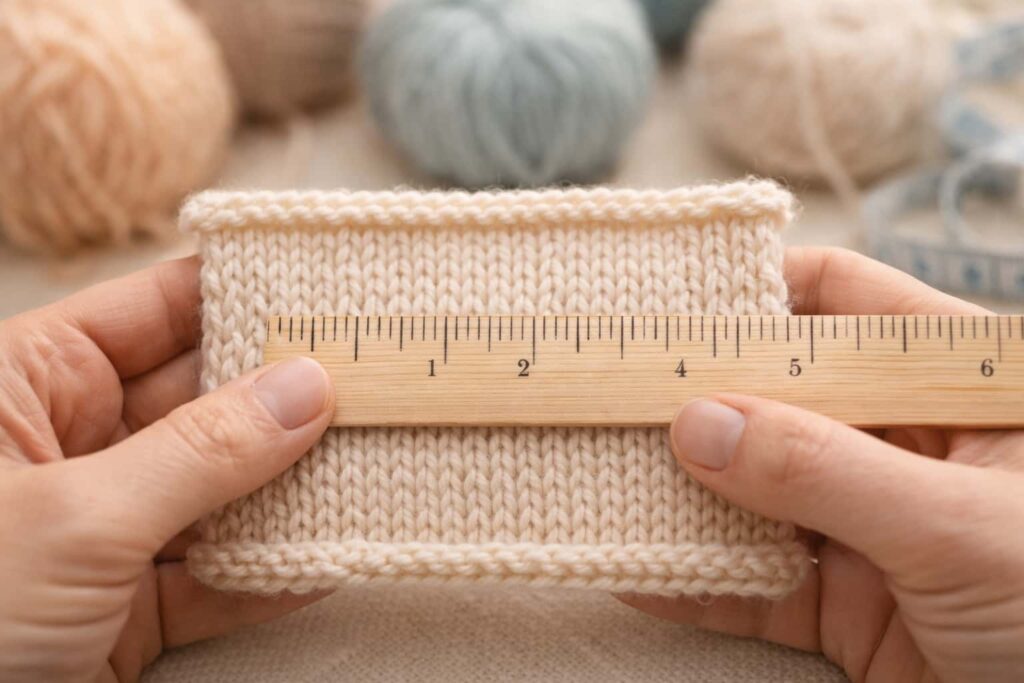
Step 3: Measure your stitches. Lay your blocked swatch flat on a hard surface. Place a ruler horizontally across the middle of the swatch and count how many stitches fall within 4 inches. Don’t measure from the very edge — start at least one stitch in from each side.
Step 4: Measure your rows. Rotate your ruler vertically and count the rows within 4 inches in the same way.
Now you have the two numbers you need: stitches per 4 inches and rows per 4 inches. These go directly into your knitting gauge calculator to unlock everything else.
You can also explore our complete gauge guide for a deeper dive into swatching techniques, common gauge problems, and how to adjust needle sizes when your gauge doesn’t match the pattern.
Your Knitting Gauge Calculator — Three Steps to Perfect Results
Tired of frogging finished projects? Enter your gauge, dimensions, and yarn details — and let the calculator handle every number for you.
- 1 Enter your gauge. Input your stitches and rows per 4 inches from your blocked swatch.
- 2 Set your dimensions. Add your desired width and length, with optional ease percentage and border stitches.
- 3 Get instant results. Cast-on count, row count, pattern repeats, and full yarn yardage — calculated in one click.
Preview only — open the full tool for live results
Knitting Gauge Calculator: Everything You Can Calculate
Our knitting gauge calculator is built to handle every variable that goes into a real-world knitting project — not just the basic stitch count. Here’s a breakdown of everything it can calculate for you.
Stitch and Row Counts
Enter your gauge (stitches and rows per 4 inches), your desired finished dimensions (width and length), and the calculator will instantly tell you how many stitches to cast on and how many rows to knit. You can work in inches or centimeters, depending on your preference.
Ease Adjustment
Ease is the difference between your body measurements and the actual size of the finished garment. Positive ease gives you a relaxed, comfortable fit. Negative ease gives you a snug, close-fitting garment. Our calculator lets you enter ease as a percentage — positive for a looser fit, negative for a tighter fit — so your final stitch count already accounts for it.
Border and Selvedge Stitches
Many patterns include selvedge stitches — extra stitches on each side used for seaming or to neaten edges. Our knitting gauge calculator lets you add border stitches to each side, so they’re factored into your total cast-on count automatically.
Pattern Repeats
If your stitch pattern has a repeat — for example, a rib that repeats every 4 stitches — you can enter that into the calculator too. It will round your stitch count up to the nearest full repeat, so your pattern always starts and ends cleanly without awkward half-repeats.
Yarn Yardage and Skein Estimates
This is one of the most practical features. Enter your yarn information — yards per skein and grams per skein — and the calculator will tell you approximately how much yarn your project requires and how many skeins to buy. No more buying too little and discovering mid-project that your dye lot is discontinued.
For more detailed yarn planning, also try our yarnage calculator, which lets you plan yarn requirements across multiple project elements.
Using the Knitting Gauge Calculator: A Step-by-Step Walkthrough
Let’s walk through a real example so you can see exactly how to use the tool.
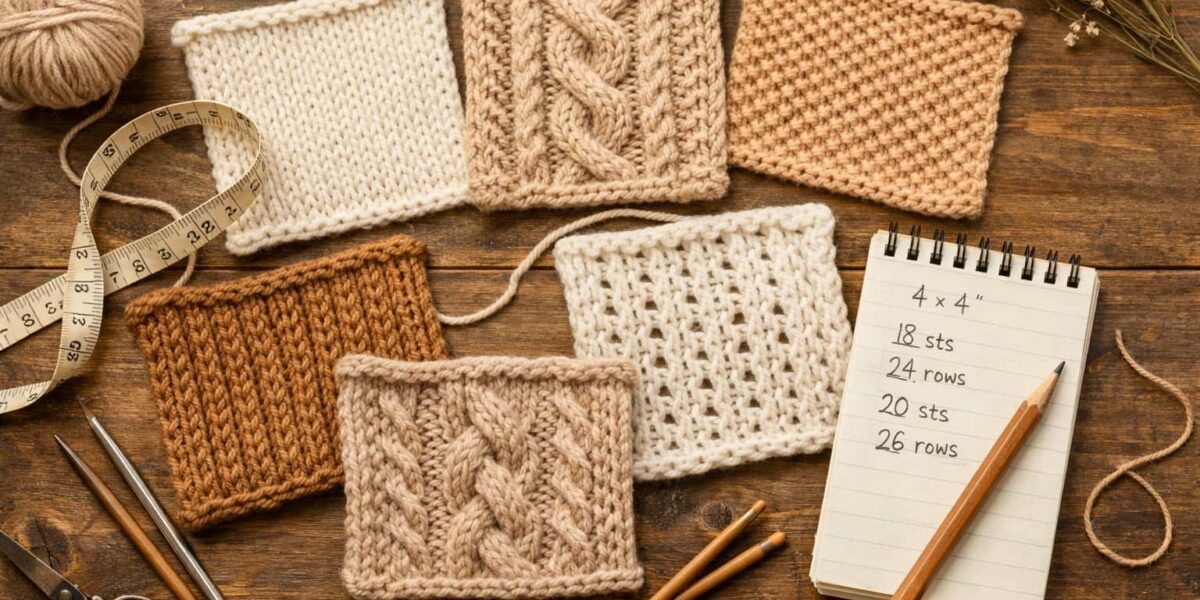
Say you’re knitting a simple blanket. Your gauge swatch shows 18 stitches and 24 rows per 4 inches. You want the finished blanket to be 20 inches wide and 24 inches long. Your yarn comes in 200-yard skeins with 100 grams per skein.
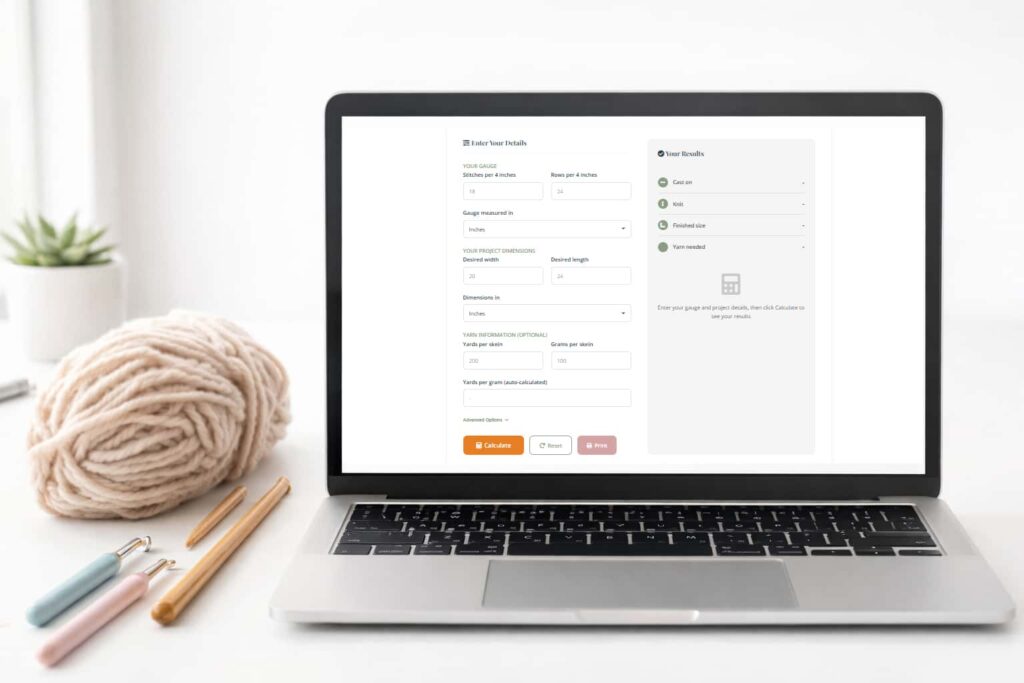
Here’s what you’d enter into the knitting gauge calculator:
- Stitches per 4 inches: 18
- Rows per 4 inches: 24
- Desired width: 20 inches
- Desired length: 24 inches
- Yards per skein: 200
- Grams per skein: 100
Hit Calculate, and the tool instantly gives you your cast-on stitch count, your total row count, and your yarn requirements — including how many skeins to purchase. If you want a border, you can add selvedge stitches. If your pattern has a stitch repeat, enter that too and let the calculator adjust your numbers automatically.
It’s a complete, all-in-one solution that replaces messy spreadsheets and error-prone manual math.
Other Tools to Use Alongside Your Gauge Calculator
Our knitting gauge calculator works best as part of a complete planning toolkit. Here are the other tools on GaugeGenie that we recommend using together:
Yarnage Calculator — Plan your yarn quantities in detail for complex multi-section projects. Perfect for sweaters, colorwork, and anything with multiple yarn colors or weights.
Stitch Counter — Keep an accurate count of your stitches and rows while you knit. Especially useful for patterns with increases, decreases, or complex shaping.
Needle Converter — Instantly convert between US, UK, and metric needle sizes. Never be confused by an international pattern again.
Gauge Guide — A comprehensive reference covering everything from how to swatch correctly to how to fix common gauge problems and substitute yarn weights.
Used together, these tools give you total control over every stage of your project — from planning and swatching to casting on and finishing.
Common Gauge Problems (and How to Fix Them)
Even with a knitting gauge calculator in your corner, things can go sideways if your initial gauge measurement is off. Here are the most common issues and how to fix them.
Too many stitches per inch (gauge is too tight): Try going up one needle size. A larger needle creates bigger loops and fewer stitches per inch.
Too few stitches per inch (gauge is too loose): Try going down one needle size. A smaller needle tightens up your tension and increases your stitch count per inch.
Gauge changes between your swatch and your project: This happens more often than you’d think, especially on larger projects where your tension naturally relaxes. Blocking your swatch before measuring helps, as does re-checking your gauge every so often as you work.
Row gauge is off but stitch gauge is right: This is very common and usually less critical in flat knitting. For patterns with specific row counts — like set-in sleeve shaping — it matters more. Adjust your needle length or try a different needle brand for different results.
Once you’ve settled your gauge, re-enter your corrected numbers into the knitting gauge calculator to get updated stitch and row counts before you cast on.
Knitting Gauge Calculator: Tips for Getting the Most Accurate Results
Getting accurate output from any knitting gauge calculator starts with accurate input. Here are a few tips to get the most reliable results every time.
Always measure your gauge from a blocked swatch, not an unblocked one. Blocking is the great equalizer — it evens out your tension and settles the yarn into its final shape.
Measure multiple times and average your results. Take three measurements in different spots across your swatch and average them for a more reliable gauge reading.
Be honest with your ease preferences. A calculator can only work with what you give it. If you say you want zero ease but you actually prefer a relaxed fit, your finished garment will feel smaller than you expected.
Update your numbers when you switch yarn or needles. Different yarns behave differently even at the same weight, and needle material — metal vs. wood vs. plastic — affects your tension. Re-swatch and re-calculate whenever you make a material change.
Try the Knitting Gauge Calculator Now — It’s Free
Ready to start knitting with confidence? Our free knitting gauge calculator is available right now, no signup required. Enter your gauge, your project dimensions, and your yarn details, and get precise stitch counts, row counts, and yarn estimates instantly.
Stop second-guessing yourself. Stop ripping out finished projects because the sizing was off. Use a knitting gauge calculator before you cast on — and knit your best project yet.
Ready to Knit Your Best Project Yet?
You’ve read the guide. You know your gauge matters. Now put it into action — our free knitting gauge calculator gives you precise stitch counts, row totals, and yarn estimates in seconds. No math, no stress, no guessing.
🔒 Free forever · No account required · Works on all devices
Have questions about gauge or need help with a specific project? Drop a comment below — we’d love to help you figure it out.